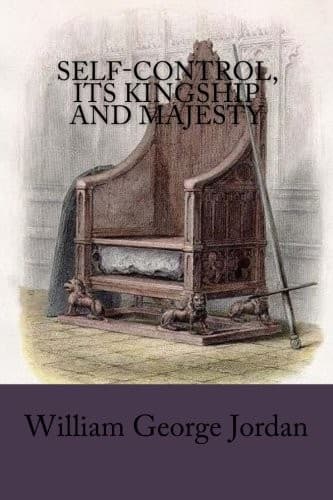
Self-Control, Its Kingship and Majesty — John Shaqi
Self-Control, Its Kingship and MajestyJordan, William George
Philosophy
Self-Control, Its Kingship and Majesty
Jordan, William George
Conduct of life; Self-control
Edwin Booth, one of the greatest actors on the American stage, would
never permit himself to assume an ungraceful attitude, even in his hours
of privacy. In this simple thing, he ever lived his best. On the stage
every move was one of unconscious grace. Those of his company who were
conscious of their motions were the awkward ones, who were seeking in
public to undo or to conceal the carelessness of the gestures and
motions of their private life. The man who is slipshod and thoughtless
in his daily speech, whose vocabulary is a collection of anæmic
commonplaces, whose repetitions of phrases and extravagance of
interjections act but as feeble disguises to his lack of ideas, will
never be brilliant on an occasion when he longs to outshine the stars.
Living at one’s best is constant preparation for instant use. It can
never make one over-precise, self-conscious, affected, or priggish.
Education, in its highest sense, is _conscious_ training of mind or body
to act _unconsciously_. It is conscious formation of mental habits, not
mere acquisition of information.
One of the many ways in which the individual unwisely eclipses himself,
is in his worship of the fetich of luck. He feels that all others are
lucky, and that whatever he attempts, fails. He does not realize the
untiring energy, the unremitting concentration, the heroic courage, the
sublime patience that is the secret of some men’s success. Their “luck”
was that they had prepared themselves to be equal to their opportunity
when it came and were awake to recognize it and receive it. His own
opportunity came and departed un-noted, it could not waken him from his
dreams of some untold wealth that would fall into his lap. So he grows
discouraged and envies those whom he should emulate, and he bandages his
arms and chloroforms his energies, and performs his duties in a
perfunctory way, or he passes through life, just ever “sampling” lines
of activity.
The honest, faithful struggler should always realize that failure is but
an episode in a true man’s life—never the whole story. It is never easy
to meet, and no philosophy can make it so, but the steadfast courage to
master conditions, instead of complaining of them, will help him on his
way; it will ever enable him to get the best out of what he has. He
never knows the long series of vanquished failures that give solidity to
someone else’s success; he does not realize the price that some rich
man, the innocent football of political malcontents and demagogues, has
heroically paid for wealth and position.
The man who has a pessimist’s doubt of all things; who demands a
certified guarantee of his future; who ever fears his work will not be
recognized or appreciated; or that after all, it is really not worth
while, will never live his best. He is dulling his capacity for real
progress by his hypnotic course of excuses for inactivity, instead of a
strong tonic of reasons for action.
Public-domain text, read in full here on John Shaqi.
Reviews
Reviews
No reviews yet
Be the first to share your thoughts on this work.
Join the Discussion
Join the discussion
Sign in to leave a comment or review.
Sign InorCreate an account