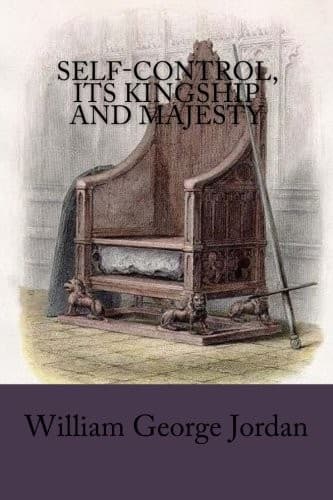
Self-Control, Its Kingship and MajestyJordan, William George
Philosophy
Self-Control, Its Kingship and Majesty
Jordan, William George
Conduct of life; Self-control
One of the most weakening elements in the individual make-up is the
surrender to the oncoming of years. Man’s self-confidence dims and dies
in the fear of age. “This new thought,” he says of some suggestion
tending to higher development, “is good; it is what we need. I am glad
to have it for my children; I would have been happy to have had some
such help when I was at school, but it is too late for me. I am a man
advanced in years.”
This is but blind closing of life to wondrous possibilities. The knell
of lost opportunity is never tolled in this life. It is never too late
to recognize truth and to live by it. It requires only greater effort,
closer attention, deeper consecration; but the impossible does not exist
for the man who is self-confident and is willing to pay the price in
time and struggle for his success or development. Later in life, the
assessments are heavier in progress, as in life insurance, but that
matters not to that mighty self-confidence that _will_ not grow old
while knowledge can keep it young.
Socrates, when his hair whitened with the snow of age, learned to play
on instruments of music. Cato, at fourscore, began his study of Greek,
and the same age saw Plutarch beginning, with the enthusiasm of a boy,
his first lessons in Latin. The Character of Man, Theophrastus’ greatest
work, was begun on his ninetieth birthday. Chaucer’s Canterbury Tales
was the work of the poet’s declining years. Ronsard, the father of
French poetry, whose sonnets even translation cannot destroy, did not
develop his poetic faculty until nearly fifty. Benjamin Franklin at this
age had just taken his really first steps of importance in philosophic
pursuits. Arnauld, the theologian and sage, translated Josephus in his
eightieth year. Winckelmann, one of the most famous writers on classic
antiquities, was the son of a shoemaker, and lived in obscurity and
ignorance until the prime of life. Hobbes, the English philosopher,
published his version of the Odyssey in his eighty-seventh year, and his
Iliad one year later. Chevreul, the great French scientist, whose
untiring labors in the realm of color have so enriched the world, was
busy, keen and active when Death called him, at the age of 103.
Public-domain text, read in full here on John Shaqi.
Reviews
Reviews
No reviews yet
Be the first to share your thoughts on this work.
Join the Discussion
Join the discussion
Sign in to leave a comment or review.
Sign InorCreate an account