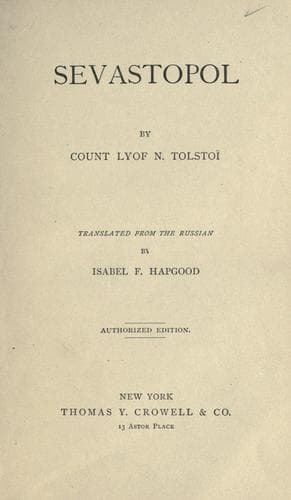
Sevastopol (Ukraine) -- History -- Siege, 1854-1855 -- Fiction
Their faces and the sound of their voices had a serious, almost
melancholy expression, as though the loss of the preceding day had
touched and saddened them deeply; but, to tell the truth, as none of
them had lost any one very near to him, this expression of sorrow was
an official expression, which they merely felt it to be their duty to
exhibit.
On the contrary, Kalugin and the colonel were ready to see an
engagement of the same sort every day, provided that they might receive
a gold sword or the rank of major-general—notwithstanding the fact that
they were very fine fellows.
I like it when any warrior who destroys millions to gratify his
ambition is called a monster. Only question any Lieutenant Petrushkoff,
and Sub-Lieutenant Antonoff, and so on, on their word of honor, and
every one of them is a petty Napoleon, a petty monster, and ready to
bring on a battle on the instant, to murder a hundred men, merely for
the sake of receiving an extra cross or an increase of a third in his
pay.
“No, excuse me,” said the colonel; “it began first on the left flank.
_I was there myself._”
“Possibly,” answered Kalugin. “_I was farther on the right; I went
there twice. Once I was in search of the general, and the second time I
went merely to inspect the lodgements. It was a hot place._”
“Yes, of course, Kalugin knows,” said Prince Galtsin to the colonel.
“You know that V. told me to-day that you were a brave fellow....”
“But the losses, the losses were terrible,” said the colonel. “_I lost
four hundred men from my regiment. It's a wonder that I escaped from
there alive._”
At this moment, the figure of Mikhaïloff, with his head bandaged,
appeared at the other extremity of the boulevard, coming to meet these
gentlemen.
“What, are you wounded, captain?” said Kalugin.
“Yes, slightly, with a stone,” replied Mikhaïloff.
“Has the flag been lowered yet?”[H] inquired Prince Galtsin, gazing
over the staff-captain's cap, and addressing himself to no one in
particular.
[H] This sentence is in French.
“Non, pas encore,” answered Mikhaïloff, who wished to show that he
understood and spoke French.
“Is the truce still in force?” said Galtsin, addressing him courteously
in Russian, and thereby intimating—so it seemed to the captain—It
must be difficult for you to speak French, so why is it not better to
talk in your own tongue simply?... And with this the adjutants left
him. The staff-captain again felt lonely, as on the preceding evening,
and, exchanging salutes with various gentlemen,—some he did not care,
and others he did not dare, to join,—he seated himself near Kazarsky's
monument, and lighted a cigarette.
Public-domain text, read in full here on John Shaqi.
Reviews
Reviews
No reviews yet
Be the first to share your thoughts on this work.
Join the Discussion
Join the discussion
Sign in to leave a comment or review.
Sign InorCreate an account