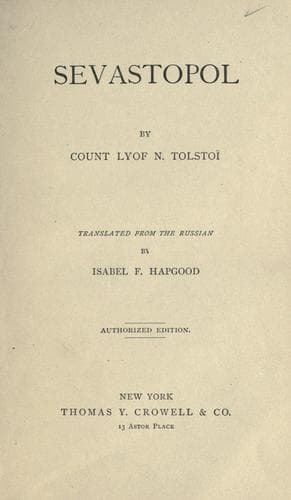
Sevastopol (Ukraine) -- History -- Siege, 1854-1855 -- Fiction
Baron Pesth also had come to the boulevard. He had been telling how he
had gone over to arrange the truce, and had conversed with the French
officers, and he declared that one had said to him, “If daylight had
held off another half-hour, these ambushes would have been retaken;”
and that he had replied, “Sir, I refrain from saying no, in order not
to give you the lie,” and how well he had said it, and so on.
But, in reality, although he had had a hand in the truce, he had not
dared to say anything very particular there, although he had been very
desirous of talking with the French (for it is awfully jolly to talk
with Frenchmen). Yunker Baron Pesth had marched up and down the line
for a long time, incessantly inquiring of the Frenchmen who were near
him: “To what regiment do you belong?” They answered him; and that was
the end of it.
When he walked too far along the line, the French sentry, not
suspecting that this soldier understood French, cursed him. “He
has come to spy out our works, the cursed ...” said he; and, in
consequence, Yunker Baron Pesth, taking no further interest in the
truce, went home, and thought out on the way thither those French
phrases, which he had now repeated. Captain Zoboff was also on the
boulevard, talking loudly, and Captain Obzhogoff, in a very dishevelled
condition, and an artillery captain, who courted no one, and was happy
in the love of the yunkers, and all the faces which had been there on
the day before, and all still actuated by the same motives. No one was
missing except Praskukhin, Neferdoff, and some others, whom hardly any
one remembered or thought of now, though their bodies were not yet
washed, laid out, and interred in the earth.
XVI.
White flags had been hung out from our bastion, and from the trenches
of the French, and in the blooming valley between them lay disfigured
corpses, shoeless, in garments of gray or blue, which laborers were
engaged in carrying off and heaping upon carts. The odor of the dead
bodies filled the air. Throngs of people had poured out of Sevastopol,
and from the French camp, to gaze upon this spectacle, and they pressed
one after the other with eager and benevolent curiosity.
Listen to what these people are saying.
Here, in a group of Russians and French who have come together, is a
young officer, who speaks French badly, but well enough to make himself
understood, examining a cartridge-box of the guards.
“And what is this bird here for?” says he.
“Because it is a cartridge-box belonging to a regiment of the guards,
Monsieur, and bears the Imperial eagle.”
“And do you belong to the guard?”
“Pardon, Monsieur, I belong to the sixth regiment of the line.”
“And this—bought where?” asks the officer, pointing to a cigar-holder
of yellow wood, in which the Frenchman was smoking his cigarette.
“At Balaklava, Monsieur. It is very plain, of palm-wood.”
“Pretty!” says the officer, guided in his conversation not so much by
his own wishes as by the words which he knows.
Public-domain text, read in full here on John Shaqi.
Reviews
Reviews
No reviews yet
Be the first to share your thoughts on this work.
Join the Discussion
Join the discussion
Sign in to leave a comment or review.
Sign InorCreate an account