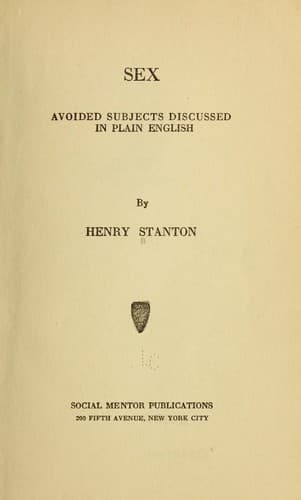
Sex: Avoided subjects Discussed in Plain English — John Shaqi
Sex: Avoided subjects Discussed in Plain EnglishStanton, Henry
Science
Sex: Avoided subjects Discussed in Plain English
Stanton, Henry
Sex -- Popular works; Sex instruction
This is fundamentally wrong. Sex affects the very root of all human
life. Its activities are not obscene, but Nature's own means to
certain legitimate ends. The sex functions, when properly controlled
and led into the proper channels, are a most essential and legitimate
form of physical self-expression. The veil of secrecy with which they
are so often shrouded tends to create an altogether false impression
regarding them. This discussion of these "Avoided Subjects," in "Plain
English," is intended to give the salient facts regarding sex in a
direct, straightforward manner, bearing in mind the true purpose of
normal sex activities.
The more we know of the facts of sex, the right and normal part sex
activities play in life, and all that tends to abuse and degrade them,
the better able we will be to make sex a factor for happiness in our
own lives and that of our descendants. Mankind, for its own general
good, must desire that reproduction--the real purpose of every sexual
function--occur in such a way as to perpetuate its own best physical
and mental qualities.
THE LAW OF PHYSICAL LIFE
It is a universal rule of physical life that every individual being
undergoes a development which we know as its individual life and
which, so far as its physical substance is concerned, ends with death.
Death is the destruction of the greater part of this individual
organism which, when death ensues, once more becomes lifeless matter.
Only small portions of this matter, the germ cells, continue to live
under certain conditions which nature has fixed.
The germ cell--as has been established by the microscope--is the tiny
cell which in the lowest living organisms as well as in man himself,
forms the unit of physical development. Yet even this tiny cell is
already a highly organized and perfected thing. It is composed of the
most widely differing elements which, taken together, form the
so-called protoplasm or cellular substance. And for all life
established in nature the cell remains the constant and unchanging
form element. It comprises the cell-protoplasm and a nucleus imbedded
in it whose substance is known as the nucleoplasm. The nucleus is the
more important of the two and, so to say, governs the life of the
cell-protoplasm.
The lower one-celled organisms in nature increase by division, just as
do the individual cells of a more highly organized, many-celled order
of living beings. And in all cases, though death or destruction of the
cells is synonymous with the death or destruction of the living
organism, the latter in most cases already has recreated itself by
reproduction.
Public-domain text, read in full here on John Shaqi.
Reviews
Reviews
No reviews yet
Be the first to share your thoughts on this work.
Join the Discussion
Join the discussion
Sign in to leave a comment or review.
Sign InorCreate an account