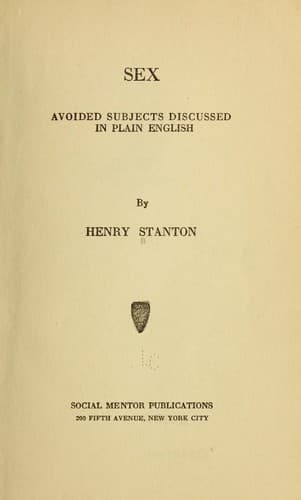
Sex: Avoided subjects Discussed in Plain English — John Shaqi
Sex: Avoided subjects Discussed in Plain EnglishStanton, Henry
Science
Sex: Avoided subjects Discussed in Plain English
Stanton, Henry
Sex -- Popular works; Sex instruction
We will not go into the very complicated details of the actual process
of the growth and division of the protoplasmic cells. It is enough to
say that in the case of living creatures provided with more
complicated organisms, such as the higher plants, animals and man, the
little cell units divide and grow as they do in the case of the lower
organisms. The fact is one which shows the intimate inner relationship
of all living beings.
THE LADDER OF ORGANIC ASCENT
As we mount the ascending ladder of plant and animal life the
unit-cell of the lower organisms is replaced by a great number of
individual cells, which have grown together to form a completed whole.
In this complete whole the cells, in accordance with the specific
purpose for which they are intended, all have a different form and a
different chemical composition. Thus it is that in the case of the
plants leaves, flowers, buds, bark, branches and stems are formed, and
in that of animals skin, intestines, glands, blood, muscles, nerves,
brain and the organs of sense. In spite of the complicated nature of
numerous organisms we find that many of them still possess the power
of reproducing themselves by division or a process of "budding." In
the case of certain plants and animals, cell-groups grow together into
a so-called "bud," which later detaches itself from the parent body
and forms a new individual living organism, as in the case of the
polyps or the tubers in plant life.
A tree, for instance, may be grown from a graft which has been cut off
and planted in the ground. And ants and bees which have not been
fecundated are quite capable of laying eggs out of which develop
perfect, well-formed descendants. This last process is called
parthenogenesis. It is a process, however, which if carried on through
several generations, ends in deterioration and degeneracy. In the case
of the higher animals, vertebrates and man, such reproduction is an
impossibility.
These higher types of animal life have been provided by nature with
special organs of reproduction and reproductive glands whose
secretions, when they are projected from the body under certain
conditions, reproduce themselves, and increase and develop in such
wise that the living organism from which they proceed is reproduced in
practically its identical form. Thus it perpetuates the original type.
Philosophically it may be said that these cells directly continue the
life of the parents, so that death in reality only destroys a part of
the individual. Every individual lives again in his offspring.
THE TRUE MISSION OF SEX
Public-domain text, read in full here on John Shaqi.
Reviews
Reviews
No reviews yet
Be the first to share your thoughts on this work.
Join the Discussion
Join the discussion
Sign in to leave a comment or review.
Sign InorCreate an account