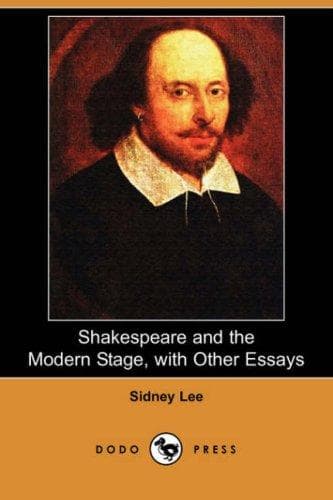
Shakespeare and the Modern Stage; with Other EssaysLee, Sidney, Sir
History
Shakespeare and the Modern Stage; with Other Essays
Lee, Sidney, Sir
Shakespeare, William, 1564-1616; Shakespeare, William, 1564-1616 -- Stage history
Such phrases sum up Shakespeare's habitual bearing to formal
philosophy. The consideration of causes, first principles, abstract
truths, never, in the dramatist's opinion, cured a human ill. The
futility of formal philosophy stands, from this point of view, in no
further need of demonstration.
II
But it is permissible to use the words philosopher and philosophy,
without scientific precision or significance, in the popular
inaccurate senses of shrewd observer and observation of life. By
philosophy we may understand common-sense wisdom about one's
fellow-men, their aspirations, their failures and successes. As soon
as we employ the word in that significance, we must allow that few men
were better philosophers than Shakespeare.
Shakespeare is what Touchstone calls the shepherd in _As You Like
It_--"a natural philosopher"--an observer by light of nature, an acute
expositor of phases of human life and feeling. Character, thought,
passion, emotion, form the raw material of which ethical or
metaphysical systems are made. The poet's contempt for formal ethical
or metaphysical theory co-existed with a searching knowledge of the
ultimate foundations of all systematised philosophic structures. The
range of fact or knowledge within which the formal theorist speculates
in the fields of ethics, logic, metaphysics, or psychology, is,
indeed, very circumscribed when it is compared with the region of
observation and experience over which Shakespeare exerted complete
mastery.
Almost every aspect of life Shakespeare portrays with singular
evenness of insight. He saw life whole. The web of life always
presented itself to him as a mingled yarn, good and ill together. He
did not stay to reconcile its contradictions. He adduces a wealth of
evidence touching ethical experience. It may be that the patient
scrutiny of formal philosophers can alone reveal the full significance
of his harvest. But the dramatist's exposition of the workings of
virtue or vice has no recondite intention. Shakespeare was no patient
scholar, who deliberately sought to extend the limits of human
knowledge. With unrivalled ease and celerity he digested, in the
recesses of his consciousness, the fruit of personal observation and
reading. His only conscious aim was to depict human conduct and human
thought. He interpreted them unconsciously by virtue of an involuntary
intuition.
Shakespeare's intuition pierces life at the lowest as well as at the
highest level of experience. It is coloured by delicate imaginative
genius as well as by robust and practical worldliness. Not his
writings only, but the facts of his private life--his mode of managing
his private property, for example--attest his alert knowledge of the
material and practical affairs of human existence. Idealism and
realism in perfect development were interwoven with the texture of his
mind.
Public-domain text, read in full here on John Shaqi.
Reviews
Reviews
No reviews yet
Be the first to share your thoughts on this work.
Elsewhere in the archive
Join the Discussion
Join the discussion
Sign in to leave a comment or review.
Sign InorCreate an account