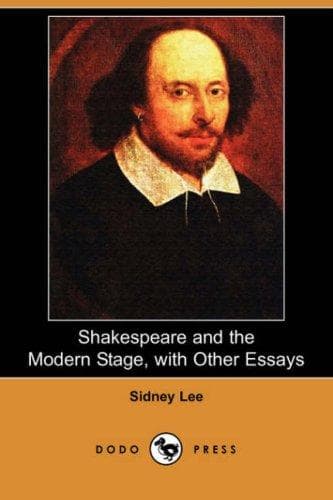
Shakespeare and the Modern Stage; with Other EssaysLee, Sidney, Sir
History
Shakespeare and the Modern Stage; with Other Essays
Lee, Sidney, Sir
Shakespeare, William, 1564-1616; Shakespeare, William, 1564-1616 -- Stage history
This is a characteristically poetic attitude; it is the antithesis of
the scientific attitude. Formal logic excited Shakespeare's disdain
even more conspicuously. In the mouths of his professional fools he
places many reductions to absurdity of what he calls the "simple
syllogism." He invests the term "chop-logic" with the significance of
foolery _in excelsis_.[26] Again, metaphysics, in any formal sense,
were clearly not of Shakespeare's world. On one occasion he wrote of
the topic round which most metaphysical speculation revolves:--
We are such stuff
As dreams are made on, and our little life
Is rounded by a sleep.
(_Tempest_, IV., i., 156-8.)
[Footnote 26: The speeches of the clown in _Twelfth Night_ are
particularly worthy of study for the satiric adroitness with which
they expose the quibbling futility of syllogistic logic. _Cf._ Act I.,
Scene v., ll. 43-57.
_Olivia._ Go to, you're a dry fool; I'll no more of you: besides you
grow dishonest.
_Clown._ Two faults, Madonna, that drink and good counsel will amend:
for give the dry fool drink, then is the fool not dry: bid the
dishonest man mend himself; if he mend, he is no longer dishonest; if
he cannot, let the botcher mend him. Anything that's mended is but
patched: virtue that transgresses is but patched with sin; and sin
that amends is but patched with virtue. If that _this simple
syllogism_ will serve, so; if it will not, what remedy?]
Such a theory of human life is first-rate poetry; it is an
illuminating figure of poetic speech. But the simplicity with which
the theme is presented, to the exclusion of many material issues, puts
the statement out of the plane of metaphysical disquisition, which
involves subtle conflict of argument and measured resolution of doubt,
rather than imaginative certainty or unconditional assertion. Nor is
Hamlet's famous soliloquy on the merits and demerits of suicide
conceived in the spirit of the metaphysician. It is a dramatic
description of a familiar phase of emotional depression; it explains
nothing; it propounds no theory. It reflects a state of feeling; it
breathes that torturing spirit of despondency which kills all hope of
mitigating either the known ills of life or the imagined terrors of
death.
The faint, shadowy glimpses which Shakespeare had of scientific
philosophy gave him small respect for it. Like the typical hard-headed
Englishman, he doubted its practical efficacy. Shakespeare viewed all
formal philosophy much as Dr Johnson's Rasselas, whose faith in it
dwindled, when he perceived that the professional philosopher, who
preached superiority to all human frailties and weaknesses, succumbed
to them at the first provocation.
There are more things in heaven and earth
Than are dreamt of in your philosophy.[27]
For there was never yet philosopher
That could endure the toothache patiently.[28]
[Footnote 27: _Hamlet_, I., v., 166-7.]
[Footnote 28: _Much Ado About Nothing_, V., i., 35-6.]
Public-domain text, read in full here on John Shaqi.
Reviews
Reviews
No reviews yet
Be the first to share your thoughts on this work.
Elsewhere in the archive
Join the Discussion
Join the discussion
Sign in to leave a comment or review.
Sign InorCreate an account