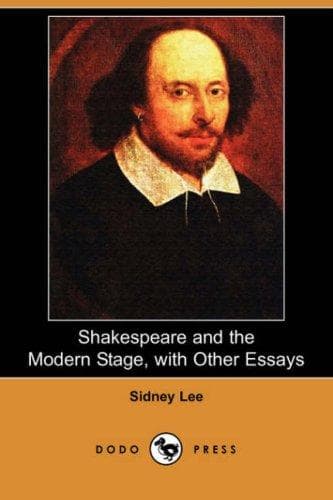
Shakespeare and the Modern Stage; with Other EssaysLee, Sidney, Sir
History
Shakespeare and the Modern Stage; with Other Essays
Lee, Sidney, Sir
Shakespeare, William, 1564-1616; Shakespeare, William, 1564-1616 -- Stage history
Shakespeare was qualified by mental endowment for success in any
career. He was by election a dramatist, and, necessarily, one of
unmatched versatility. His intuitive faculty enabled him, after
regarding life from any point of view that he willed, to depict
through the mouths of his characters the chosen phase of experience in
convincing, harmonious accord with his characters' individual
circumstances and fortunes. No obvious trace of his own personal
circumstance or experience was suffered to emerge in the utterances of
his characters, who lived for the moment in his brain. It is a
commonplace to credit Shakespeare with supreme dramatic instinct. It
is difficult fully to realise the significance of that attribute. It
means that he could contract or expand at will and momentarily, his
own personality, so that it coincided exactly, now with a
self-indulgent humorist like Falstaff, now with an introspective
student like Hamlet, now with a cynical criminal like Iago, now with a
high-spirited girl like Rosalind, now with an ambitious woman like
Lady Macbeth, and then with a hundred more characters hardly less
distinctive than these. It means that he could contrive the
coincidence so absolutely as to leave no loophole for the
introduction, into the several dramatic utterances, of any sentiment
that should not be on the face of it adapted by right of nature to the
speakers' idiosyncracies. That was Shakespeare's power. It is a power
of which the effects are far easier to recognise than the causes or
secret of operation.
In the present connection it is happily only necessary to dwell on
Shakespeare's dramatic instinct in order to guard against the peril of
dogmatising from his works about his private opinions. So various and
conflicting are Shakespeare's dramatic pronouncements on phases of
experience that it is difficult and dangerous to affirm which
pronouncements, if any, present most closely his personal sentiment.
He fitted the lips of his _dramatis personae_ with speeches and
sentiments so peculiarly adapted to them as to show no one quite
undisputed sign of their creator's personality.
Public-domain text, read in full here on John Shaqi.
Reviews
Reviews
No reviews yet
Be the first to share your thoughts on this work.
Elsewhere in the archive
Join the Discussion
Join the discussion
Sign in to leave a comment or review.
Sign InorCreate an account