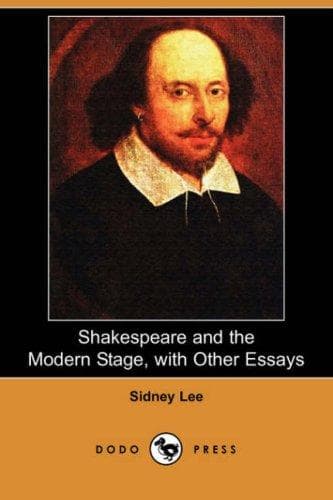
Shakespeare and the Modern Stage; with Other EssaysLee, Sidney, Sir
History
Shakespeare and the Modern Stage; with Other Essays
Lee, Sidney, Sir
Shakespeare, William, 1564-1616; Shakespeare, William, 1564-1616 -- Stage history
Yet there are occasions, when, without detracting from the omnipotence
of Shakespeare's dramatic instinct, one may tentatively infer that
Shakespeare gave voice through his created personages to sentiments
which were his own. The Shakespearean drama must incorporate somewhere
within its vast limits the personal thoughts and passions of its
creator, even although they are for the most part absorbed past
recognition in the mighty mass, and no critical chemistry can with
confidence disentangle them. At any rate, there are in the plays many
utterances--ethical utterances, or observations conceived in the
spirit of "a natural philosopher"--which are repeated to much the same
effect at different periods of the poet's career. These reiterated
opinions frequently touch the conditions of well-being or calamity in
civilised society; they often deal with man in civic or social
relation with his neighbour; they define the capabilities of his will.
It is unlikely that observations of this nature would be repeated if
the sentiments they embody were out of harmony with the author's
private conviction. Often we shall not strain a point or do our
critical sense much violence if we assume that these recurring
thoughts are Shakespeare's own. I purpose to call attention to a few
of those which bear on large questions of government and citizenship
and human volition. Involuntarily, they form the framework of a
political and moral philosophy which for clear-eyed sanity is without
rival.
III
Shakespeare's political philosophy is instinct with the loftiest moral
sense. Directly or indirectly, he defines many times the essential
virtues and the inevitable temptations which attach to persons
exercising legalised authority over their fellow-men. The topic always
seems to stir in Shakespeare his most serious tone of thought and
word. No one, in fact, has conceived a higher standard of public
virtue and public duty than Shakespeare. His intuition rendered him
tolerant of human imperfection. He is always in kindly sympathy with
failure, with suffering, with the oppressed. Consequently he brings at
the outset into clearer relief than professed political philosophers,
the saving quality of mercy in rulers of men. Twice Shakespeare pleads
in almost identical terms, through the mouths of created characters,
for generosity on the part of governors of states towards those who
sin against law. In both cases he places his argument, with
significant delicacy, on the lips of women. At a comparatively early
period in his career as dramatist, in _The Merchant of Venice_, Portia
first gave voice to the political virtue of compassion. At a much
later period Shakespeare set the same plea in the mouth of Isabella in
_Measure for Measure_. The passages are too familiar to justify
quotation. Very brief extracts will bring out clearly the identity of
sentiment which finds definition in the two passages.
Public-domain text, read in full here on John Shaqi.
Reviews
Reviews
No reviews yet
Be the first to share your thoughts on this work.
Elsewhere in the archive
Join the Discussion
Join the discussion
Sign in to leave a comment or review.
Sign InorCreate an account