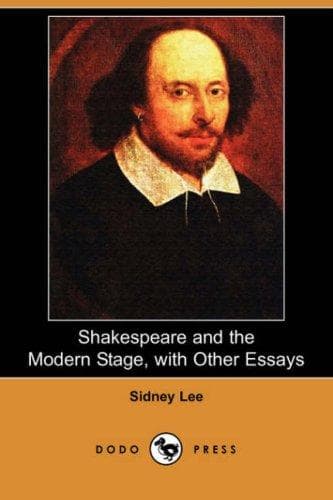
Shakespeare and the Modern Stage; with Other EssaysLee, Sidney, Sir
History
Shakespeare and the Modern Stage; with Other Essays
Lee, Sidney, Sir
Shakespeare, William, 1564-1616; Shakespeare, William, 1564-1616 -- Stage history
These are Portia's views of mercy on the throne (_Merchant of Venice_,
IV., i., 189 _seq._):--
'Tis mightiest in the mightiest; it becomes
The throned monarch better than his crown;
* * * * *
Mercy is above this sceptred sway;
It is enthroned in the hearts of kings,
It is an attribute to God himself;
And earthly power doth then show likest God's
When mercy seasons justice.
Consider this,
That in the course of justice none of us
Should see salvation.[29]
[Footnote 29: In a paper on "Latin as an Intellectual Force," read
before the International Congress of Arts and Sciences at St Louis in
September 1904, Professor E.A. Sonnenschein sought to show that
Portia's speech on mercy is based on Seneca's tract, _De Clementia_.
The most striking parallel passages are the following:--
It becomes
The throned monarch better than his crown.
(_M. of V._, IV., i. 189-90.)
Nullum clementia ex omnibus magis quam regem aut principem decet.
(Seneca, _De Clementia_, I., iii., 3):--
'Tis mightiest in the mightiest.
Eo scilicet formosius id esse magnificentiusque fatebimur quo in
maiore praestabitur potestate (I., xix., 1):--
But mercy is above this sceptred sway;
It is enthroned in the hearts of kings,
It is an attribute to God himself.
(_M. of V._, IV., i., 193-5.)
Quod si di placabiles et aequi delicta potentium non statim fulminibus
persequuntur, quanto aequius est hominem hominibus praepositum miti
animo exercere imperium? (I., vii., 2):--
And earthly power doth then show likest God's
When mercy seasons justice.
(_M. of V._, IV., i., 196-7.)
Quid autem? Non proximum eis (dis) locum tenet is qui se ex deorum
natura gerit beneficus et largus et in melius potens? (I., xix., 9):--
Consider this,
That in the course of justice none of us
Should see salvation.
(_M. of V._, IV., i., 198-200.)
Cogitato ... quanta solitudo et vastitas futura sit si nihil
relinquitur nisi quod iudex severus absolverit (I., vi., 1).
This remarkable series of parallelisms does not affect the argument in
the text that Shakespeare, who reiterated Portia's pleas and
phraseology in Isabella's speeches, had a personal faith in the
declared sentiment. Whether the parallelism is to be explained as
conscious borrowing or accidental coincidence is an open question.]
Here are Isabella's words in _Measure for Measure_ (II., ii., 59
_seq._):--
No ceremony that to great ones 'longs,
Not the king's crown, nor the deputed sword,
The marshal's truncheon, nor the judge's robe,
Become them with one half so good a grace
As mercy does.
How would you be
If He, which is the top of judgment, should
But judge you as you are?
Public-domain text, read in full here on John Shaqi.
Reviews
Reviews
No reviews yet
Be the first to share your thoughts on this work.
Elsewhere in the archive
Join the Discussion
Join the discussion
Sign in to leave a comment or review.
Sign InorCreate an account