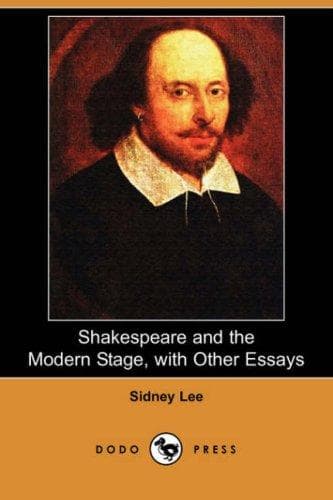
Shakespeare and the Modern Stage; with Other EssaysLee, Sidney, Sir
History
Shakespeare and the Modern Stage; with Other Essays
Lee, Sidney, Sir
Shakespeare, William, 1564-1616; Shakespeare, William, 1564-1616 -- Stage history
_Cant._ Therefore doth heaven divide
The state of man in divers functions,
Setting endeavour in continual motion;
To which is fixed, as an aim or butt,
Obedience: for so work the honey-bees,
Creatures that by a rule in nature teach
The act of order to a peopled kingdom.
(_Henry V._, I., ii., 180-9.)
There follows a very suggestive comparison between the commonwealth of
bees and the economy of human society. The well-worn comparison has
been fashioned anew by a writer of genius of our own day, M.
Maeterlinck.
In _Troilus and Cressida_ (I., iii., 85 _seq._) Shakespeare returns to
the discussion, and defines with greater precision "the specialty of
rule." There he approaches nearer than anywhere else in his writings
the sphere of strict philosophic exposition. He argues that:--
The heavens themselves, the planets, and this centre,
Observe degree, priority, and place,
Insisture, course, proportion, season, form,
Office, and custom in all line of order.
Human society is bound to follow this celestial example. At all
hazards, one must protect "the unity and married calm of states."
Degree, order, discipline, are the only sure safeguards against brute
force and chaos which civilised institutions exist to hold in check:--
How could communities,
Degrees in schools and brotherhoods in cities,
Peaceful commerce from dividable shores,
The primogeniture and due of birth,
Prerogative of age, crowns, sceptres, laurels,
But by degree stand in authentic place?
Take but degree away, untune that string,
And, hark, what discord follows! each thing meets
In mere oppugnancy: the bounded waters
Should lift their bosoms higher than the shores,
And make a sop of all this solid globe:
Strength should be lord of imbecility,
And the rude son should strike his father dead:
Force should be right; or rather, right and wrong,
Between whose endless jar justice resides,
Should lose their names, and so should justice too.
Then every thing includes itself in power,
Power into will, will into appetite;
And appetite, an universal wolf,
So doubly seconded with will and power,
Must make perforce an universal prey,
And last eat up himself.
Deprived of degree, rank, order, society dissolves itself in "chaos."
Near the end of his career, Shakespeare impressively re-stated his
faith in the imperative need of the due recognition of social rank and
grade in civilised communities. In _Cymbeline_ (IV., ii., 246-9) "a
queen's son" meets his death in fight with an inferior, and the
conqueror is inclined to spurn the lifeless corpse. But a wise veteran
solemnly uplifts his voice to forbid the insult. Appeal is made to the
sacred principle of social order, which must be respected even in
death:--
Public-domain text, read in full here on John Shaqi.
Reviews
Reviews
No reviews yet
Be the first to share your thoughts on this work.
Elsewhere in the archive
Join the Discussion
Join the discussion
Sign in to leave a comment or review.
Sign InorCreate an account