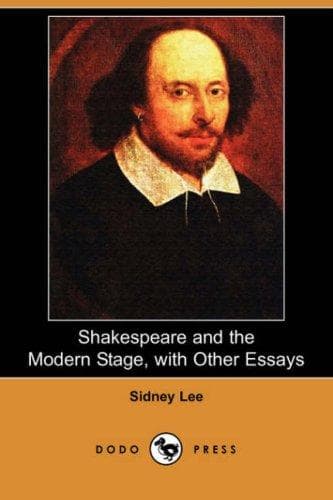
Shakespeare and the Modern Stage; with Other EssaysLee, Sidney, Sir
History
Shakespeare and the Modern Stage; with Other Essays
Lee, Sidney, Sir
Shakespeare, William, 1564-1616; Shakespeare, William, 1564-1616 -- Stage history
The leading principles, to which Phelps strictly adhered throughout
his career of management, call for most careful consideration. He
gathered round him a company of actors and actresses, whom he
zealously trained to interpret Shakespeare's language. He accustomed
his colleagues to act harmoniously together, and to sacrifice to the
welfare of the whole enterprise individual pretensions to prominence.
No long continuous run of any one piece was permitted by the rules of
the playhouse. The programme was constantly changed. The scenic
appliances were simple, adequate, and inexpensive. The supernumerary
staff was restricted to the smallest practicable number. The general
expenses were consequently kept within narrow limits. For every
thousand pounds that Charles Kean laid out at the Princess's Theatre
on scenery and other expenses of production, Phelps in his most ornate
revivals spent less than a fourth of that sum. For the pounds spent by
managers on more recent revivals, Phelps would have spent only as many
shillings. In the result, Phelps reaped from the profits of his
a handsome unencumbered income. During the same period Charles
Kean grew more and more deeply involved in oppressive debt, and at a
later date Sir Henry Irving made over to the public a hundred thousand
pounds above his receipts.
VI
Why, then, should not Phelps's encouraging experiment be made
again?[3]
[Footnote 3: It is just to notice, among endeavours of the late years
of the past century, to which I confine my remarks here, the efforts
to produce Shakespearean drama worthily which were made by Charles
Alexander Calvert at the Prince's Theatre, Manchester, between 1864
and 1874. Calvert, who was a warm admirer of Phelps, attempted to
blend Phelps's method with Charles Kean's, and bestowed great scenic
elaboration on the production of at least eight plays of Shakespeare.
Financially the speculation saw every vicissitude, and Calvert's
experience may be quoted in support of the view that a return to
Phelps's method is financially safer than a return to Charles Kean's.
More recently the Elizabethan Stage Society endeavoured to produce,
with a simplicity which erred on the side of severity, many plays of
Shakespeare and other literary dramas. No scenery was employed, and
the performers were dressed in Elizabethan costume. The Society's work
was done privately, and did not invite any genuine test of publicity.
The representation by the Society on November 11, 1899, in the Lecture
Theatre at Burlington House, of _Richard II._, in which Mr Granville
Barker played the King with great charm and judgment, showed the
fascination that a competent rendering of Shakespeare's text exerts,
even in the total absence of scenery, over a large audience of
suitable temper.]
Public-domain text, read in full here on John Shaqi.
Reviews
Reviews
No reviews yet
Be the first to share your thoughts on this work.
Join the Discussion
Join the discussion
Sign in to leave a comment or review.
Sign InorCreate an account