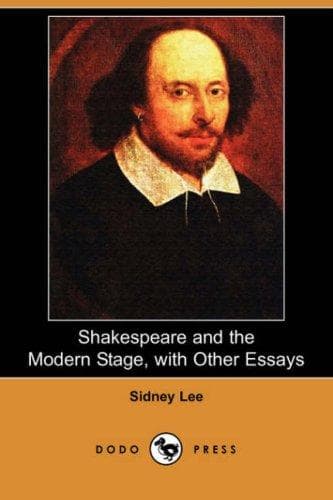
Shakespeare and the Modern Stage; with Other EssaysLee, Sidney, Sir
History
Shakespeare and the Modern Stage; with Other Essays
Lee, Sidney, Sir
Shakespeare, William, 1564-1616; Shakespeare, William, 1564-1616 -- Stage history
Before anyone may commit himself to an affirmative reply, it is
needful for him to realise fully the precise demands which a system
like that of Phelps makes, when rightly interpreted, on the character,
ability, and energy of the actors and actresses. If scenery in
Shakespearean productions be relegated to its proper place in the
background of the stage, it is necessary that the acting, from top to
bottom of the cast, shall be more efficient and better harmonised than
that which is commonly associated with spectacular representations.
The simple method of producing Shakespeare focusses the interest of
the audience on the actor and actress; it gives them a dignity and
importance which are unknown to the complex method. Under the latter
system, the attention of the spectator is largely absorbed by the
triumphs of the scene-painter and machinist, of the costumier and the
musicians. The actor and actress often elude notice altogether.
Macready, whose theatrical career was anterior to the modern
spectacular period of Shakespearean representation, has left on record
a deliberate opinion of Charles Kean's elaborate methods at the
Princess's Theatre in their relation to drama and the histrionic art.
Macready's verdict has an universal application. "The production of
the Shakespearean plays at the Princess's Theatre," the great actor
wrote to Lady Pollock on the 1st of May 1859, rendered the spoken text
"more like a running commentary on the spectacles exhibited than the
scenic arrangements an illustration of the text." No criticism could
define more convincingly the humiliation to which the author's words
are exposed by spectacle, or, what is more pertinent to the immediate
argument, the evil which is worked by spectacle on the actor.
Acting can be, and commonly tends to be, the most mechanical of
physical exercises. The actor is often a mere automaton who repeats
night after night the same unimpressive trick of voice, eye, and
gesture. His defects of understanding may be comparatively unobtrusive
in a spectacular display, where he is liable to escape censure by
escaping observation, or at best to be regarded as a showman.
Furthermore, the long runs which scenic excess brings in its train
accentuate the mechanical actor's imperfections and diminish his
opportunities of remedying them. On the other hand, acting can rise in
opposite conditions into the noblest of the arts. The great actor
relies for genuine success on no mere gesticulatory mechanism.
Imaginative insight, passion, the gift of oratory, grace and dignity
of movement and bearing, perfect command of the voice in the whole
gamut of its inflections are the constituent qualities of true
histrionic capacity.
Public-domain text, read in full here on John Shaqi.
Reviews
Reviews
No reviews yet
Be the first to share your thoughts on this work.
Join the Discussion
Join the discussion
Sign in to leave a comment or review.
Sign InorCreate an account