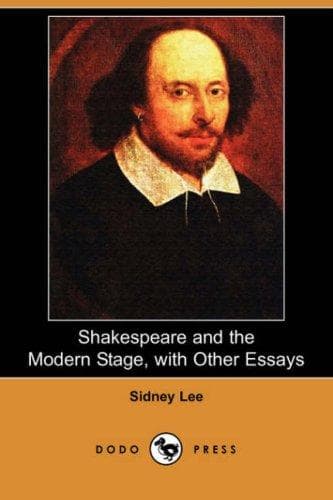
Shakespeare and the Modern Stage; with Other EssaysLee, Sidney, Sir
History
Shakespeare and the Modern Stage; with Other Essays
Lee, Sidney, Sir
Shakespeare, William, 1564-1616; Shakespeare, William, 1564-1616 -- Stage history
Such an exordium as the chorus before _Henry V._ would indeed be
pertinent to every stage performance of great drama in any age or
country. It matters not whether the spectacular machinery be of royal
magnificence or of poverty-stricken squalor. Let us make the
extravagant assumption that all the artistic genius in the world and
all the treasure in the Bank of England were placed at the command of
a theatrical manager in order to enable him to produce a great play on
his stage supremely well from his own scenic point of view. Even then
it would be neither superfluous nor impertinent for the manager to
adjure the audience to piece out the "imperfections" of the scenery
with their "thoughts" or imagination. The spectator's "imaginary
puissance" is, practically in every circumstance, the key-stone of the
dramatic illusion.
The only conditions in which Shakespeare's adjuration would be
superfluous or impertinent would accompany the presentment in the
theatre of some circumscribed incident of life which is capable of so
literal a rendering as to leave no room for any make-believe or
illusion at all. The unintellectual playgoer, to whom Shakespeare will
never really prove attractive in any guise, has little or no
imagination to exercise, and he only tolerates a performance in the
theatre when little or no demand is made on the exercise of the
imaginative faculty. "The groundlings," said Shakespeare for all time,
"are capable of [appreciating] nothing but inexplicable dumb shows and
noise." They would be hugely delighted nowadays with a scene in which
two real motor cars, with genuine chauffeurs and passengers, raced
uproariously across the stage. That is realism in its nakedness. That
is realism reduced to its first principles. Realistic "effects,"
however speciously beautiful they may be, invariably tend to realism
of that primal type, which satisfies the predilections of the
groundling, and reduces drama to the level of the cinematograph.
IX
The deliberate pursuit of scenic realism is antagonistic to the
ultimate law of dramatic art. In the case of great plays, the dramatic
representation is most successful from the genuinely artistic point of
view--which is the only point of view worthy of discussion--when the
just dramatic illusion is produced by simple and unpretending scenic
appliances, in which the inevitable "imperfections" are frankly left
to be supplied by the "thoughts" or imagination of the spectators.
Public-domain text, read in full here on John Shaqi.
Reviews
Reviews
No reviews yet
Be the first to share your thoughts on this work.
Join the Discussion
Join the discussion
Sign in to leave a comment or review.
Sign InorCreate an account