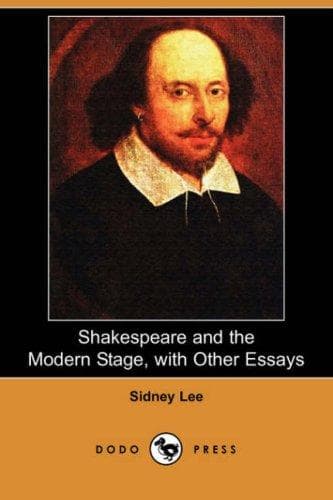
Shakespeare and the Modern Stage; with Other Essays — John Shaqi
Shakespeare and the Modern Stage; with Other EssaysLee, Sidney, Sir
History
Shakespeare and the Modern Stage; with Other Essays
Lee, Sidney, Sir
Shakespeare, William, 1564-1616; Shakespeare, William, 1564-1616 -- Stage history
Shortly stated, Shakespeare's splendid prelude to his play of _Henry
V._, is a spirited appeal to his audience not to waste regrets on
defects of stage machinery, but to bring to the observation of his
piece their highest powers of imagination, whereby alone can full
justice be done to a majestic theme. The central topic of the choric
speech is the essential limitations of all scenic appliances. The
dramatist reminds us that the literal presentation of life itself, in
all its movement and action, lies outside the range of the stage,
especially the movement and action of life in its most glorious
manifestations. Obvious conditions of space do not allow "two mighty
monarchies" literally to be confined within the walls of a theatre.
Obvious conditions of time cannot turn "the accomplishments of many
years into an hour glass." Shakespeare is airing no private grievance.
He is not complaining that his plays were in his own day inadequately
upholstered in the theatre, or that the "scaffold" on which they were
produced was "unworthy" of them. The words have no concern with the
contention that modern upholstery and spectacular machinery render
Shakespeare's play a justice which was denied them in his lifetime. As
reasonably one might affirm that the modern theatre has now conquered
the ordinary conditions of time and space; that a modern playhouse
can, if the manager so will it, actually hold within its walls the
"vasty fields of France," or confine "two mighty monarchies."
A wider and quite impersonal trend of thought is offered for
consideration by Shakespeare's majestic eloquence. The dramatist bids
us bear in mind that his lines do no more than suggest the things he
would have the audience see and understand; the actors aid the
suggestion according to their ability. But the crucial point of the
utterance is the warning that the illusion of the drama can only be
rendered complete in the theatre by the working of the "imaginary
forces" of the spectators. It is needful for them to "make imaginary
puissance," if the play is to triumph. It is their "thoughts" that
"must deck" the kings of the stage, if the dramatist's meaning is to
get home. The poet modestly underestimated the supreme force of his
own imaginative genius when giving these admonitions to his hearers.
But they are warnings of universal application, and can never be
safely ignored.
Public-domain text, read in full here on John Shaqi.
Reviews
Reviews
No reviews yet
Be the first to share your thoughts on this work.
Join the Discussion
Join the discussion
Sign in to leave a comment or review.
Sign InorCreate an account