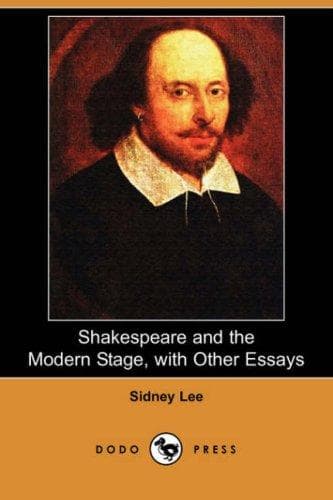
Shakespeare and the Modern Stage; with Other Essays — John Shaqi
Shakespeare and the Modern Stage; with Other EssaysLee, Sidney, Sir
History
Shakespeare and the Modern Stage; with Other Essays
Lee, Sidney, Sir
Shakespeare, William, 1564-1616; Shakespeare, William, 1564-1616 -- Stage history
Very early in his career did Shakespeare attract the notice of the
cultivated section of Elizabeth's Court, and hardly sufficient notice
has been taken by students of the poet's biography of the earliest
recognition accorded him by the great queen, herself an inveterate
lover of the drama, and an embodiment of the taste of the people in
literature. The story is worth retelling. In the middle of December
1594, Queen Elizabeth removed from Whitehall to Greenwich to spend
Christmas at that palace of Greenwich in which she was born sixty-one
years earlier. And she made the celebration of Christmas of 1594 more
memorable than any other in the annals of her reign or in the literary
history of the country by summoning Shakespeare to Court. It was less
than eight years since the poet had first set foot in the metropolis.
His career was little more than opened. But by 1594 Shakespeare had
given his countrymen unmistakable indications of the stuff of which he
was made. His progress had been more sure than rapid. A young man of
two-and-twenty, burdened with a wife and three children, he had left
his home in the little country town of Stratford-on-Avon in 1586 to
seek his fortune in London. Without friends, without money, he had,
like any other stage-struck youth, set his heart on becoming an actor
in the metropolis. Fortune favoured him. He sought and won the humble
office of call-boy in a London playhouse; but no sooner had his foot
touched the lowest rung of the theatrical ladder than his genius
taught him that the topmost rung was within his reach. He tried his
hand on the revision of an old play, and the manager was not slow to
recognise an unmatched gift for dramatic writing.
It was not probably till 1591, when Shakespeare was twenty-seven, that
his earliest original play, _Love's Labour's Lost_, was performed. It
showed the hand of a beginner; it abounded in trivial witticisms. But
above all, there shone out clearly and unmistakably the dramatic and
poetic fire, the humorous outlook on life, the insight into human
feeling, which were to inspire Titanic achievements in the future.
Public-domain text, read in full here on John Shaqi.
Reviews
Reviews
No reviews yet
Be the first to share your thoughts on this work.
Join the Discussion
Join the discussion
Sign in to leave a comment or review.
Sign InorCreate an account