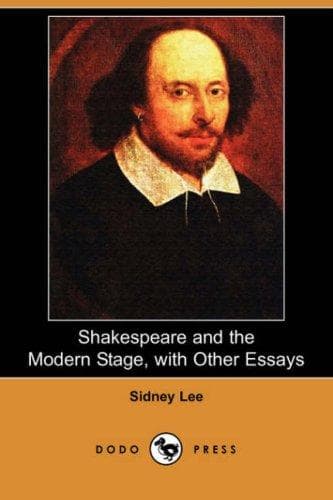
Shakespeare and the Modern Stage; with Other Essays — John Shaqi
Shakespeare and the Modern Stage; with Other EssaysLee, Sidney, Sir
History
Shakespeare and the Modern Stage; with Other Essays
Lee, Sidney, Sir
Shakespeare, William, 1564-1616; Shakespeare, William, 1564-1616 -- Stage history
The most striking defect in the practice of the Elizabethan playhouse,
according to accepted notions, lies in the allotment of the female
roles. It was thought unseemly for women to act at all. Female parts
were played by boys or men--a substitution lacking, from the modern
point of view, in grace and seemliness. But the standard of propriety
in such matters varies from age to age. Shakespeare alludes quite
complacently to the appearance of boys and men in women's parts. He
makes Rosalind say, laughingly and saucily, to the men of the
audience in the epilogue to _As You Like It_: "If I were a woman I
would kiss as many of you as had beards that pleased me." "_If I were_
a woman," she says. The jest lies in the fact that the speaker was not
a woman but a boy. Similarly, Cleopatra on her downfall in _Antony and
Cleopatra_, (V. ii. 220), laments
the quick comedians
Extemporally will stage us ... and I shall see
Some squeaking Cleopatra _boy_ my greatness.
The experiment of entrusting a boy with the part of Ophelia was lately
tried in London not unsuccessfully; but it is difficult to realise how
a boy or young man could adequately interpret most of Shakespeare's
female characters. It seems almost sacrilegious to conceive the part
of Cleopatra, the most highly sensitised in its minutest details of
all dramatic portrayals of female character,--it seems almost
sacrilegious to submit Cleopatra's sublimity of passion to
interpretation by an unfledged representative of the other sex. Yet
such solecisms were imperative under the theatrical system of the late
sixteenth and early seventeenth centuries. Men taking women's parts
seem to have worn masks, but that can hardly have improved matters.
Flute, when he complains that it would hardly befit him to play a
woman's part because he had a beard coming, is bidden by his
resourceful manager, Quince, play Thisbe in a "mask." At times actors
who had long lost the roses of youth masqueraded in women's roles.
Thereby the ungainliness, which marked the distribution of the cast in
Elizabethan and Jacobean playhouses, was often forced into stronger
light.
It was not till the seventeenth century was well advanced that women
were permitted to act in public theatres. Then the gracelessness of
the masculine method was acknowledged and deplored. It was the
character of Desdemona which was first undertaken by a woman, and the
absurdity of the old practice was noticed in the prologue written for
this revival of _Othello_, which was made memorable by the innovation.
Some lines in the prologue describe the earlier system thus:--
For to speak truth, men act, that are between
Forty or fifty, wenches of fifteen,
With bone so large and nerve so uncompliant,
When you call Desdemona, enter Giant.
Public-domain text, read in full here on John Shaqi.
Reviews
Reviews
No reviews yet
Be the first to share your thoughts on this work.
Join the Discussion
Join the discussion
Sign in to leave a comment or review.
Sign InorCreate an account