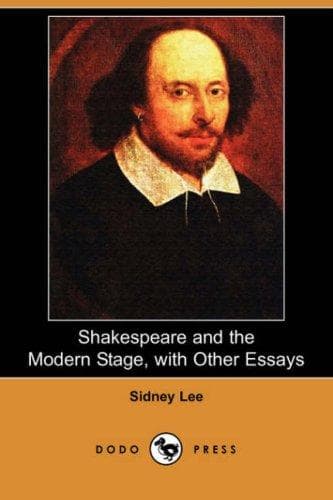
Shakespeare and the Modern Stage; with Other EssaysLee, Sidney, Sir
History
Shakespeare and the Modern Stage; with Other Essays
Lee, Sidney, Sir
Shakespeare, William, 1564-1616; Shakespeare, William, 1564-1616 -- Stage history
_Othello_ he saw twice, and he tells us more of the acting than of the
play itself. On his first visit he notes that the lady next him
shrieked on seeing Desdemona smothered: a proof of the strength of the
histrionic illusion. Up to the year 1666 Pepys adhered to the
praiseworthy opinion that _Othello_ was a "mighty good" play. But in
that year his judgment took a turn for the worse, and that for a
reason which finally convicts him of incapacity to pass just sentence
on the poetic or literary drama. On August 20, 1666, he writes: "Read
_Othello, Moor of Venice_, which I have ever heretofore esteemed a
mighty good play; but having so lately read the _Adventures of Five
Hours_, it seems a mean thing."
Most lovers of Shakespeare will agree that the great dramatist rarely
showed his mature powers to more magnificent advantage than in his
treatment of plot and character in _Othello_. What, then, is this
_Adventures of Five Hours_, compared with which _Othello_ became in
Pepys's eyes "a mean thing"? It is a trivial comedy of intrigue,
adapted from the Spanish by one Sir Samuel Tuke. A choleric guardian
arranges for his ward, who also happens to be his sister, to marry
against her will a man whom she has never seen. Without her guardian's
knowledge she, before the design goes further, escapes with a lover of
her own choosing. In her place she leaves a close friend, who is wooed
in mistake for herself by the suitor destined for her own hand. This
is the main dramatic point; the thread is very slender, and is drawn
out to its utmost limits through five acts of blank verse. The
language and metre are scrupulously correct. But one cannot credit the
play with any touch of poetry or imagination. It presents a trite
theme tamely and prosaically. Congenital inability of the most
inveterate toughness to appreciate dramatic poetry could alone account
for a mention of the _Adventures of Five Hours_ in the same breath
with _Othello_.
Pepys did not again fall so low as this. The only other tragedy of
Shakespeare which he saw in its authentic purity moved him,
contradictorily, to transports of unqualified delight. One is glad to
recall that _Hamlet_, one of the greatest of Shakespeare's plays,
received from Pepys ungrudging commendation. Pepys's favourable
opinion of _Hamlet_ is to be assigned to two causes. One is the
literary and psychological attractions of the piece; the other, and
perhaps the more important, is the manner in which the play was
interpreted on the stage of Pepys's time.
Public-domain text, read in full here on John Shaqi.
Reviews
Reviews
No reviews yet
Be the first to share your thoughts on this work.
Elsewhere in the archive
Join the Discussion
Join the discussion
Sign in to leave a comment or review.
Sign InorCreate an account