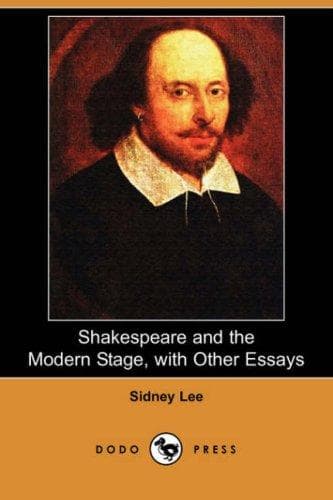
Shakespeare and the Modern Stage; with Other EssaysLee, Sidney, Sir
History
Shakespeare and the Modern Stage; with Other Essays
Lee, Sidney, Sir
Shakespeare, William, 1564-1616; Shakespeare, William, 1564-1616 -- Stage history
Pepys is not the only owner of a prosaic mind who has found
satisfaction in Shakespeare's portrait of the Prince of Denmark. Over
minds of almost every calibre, that hero of the stage has always
exerted a pathetic fascination, which natural antipathy to poetry
seems unable to extinguish. Pepys's testimony to his respect for the
piece is abundant. The whole of one Sunday afternoon (November 13,
1664), he spent at home with his wife, "getting a speech out of
_Hamlet_, 'To be or not to be,' without book." He proved, indeed, his
singular admiration for those familiar lines in a manner which I
believe to be unique. He set them to music, and the notes are extant
in a book of manuscript music in his library at Magdalene College,
Cambridge. The piece is a finely-elaborated recitative fully equal to
the requirements of grand opera. The composer gives intelligent and
dignified expression to every word of the soliloquy. Very impressive
is the modulation of the musical accompaniment to the lines--
To die, to sleep!
To sleep, perchance to dream! ay, there's the rub.
It is possible that the cadences of this musical rendering of Hamlet's
speech preserve some echo of the intonation of the great actor,
Betterton, whose performance evoked in Pepys lasting adoration.[18]
[Footnote 18: Sir Frederick Bridge, by permission of the Master and
Fellows of Magdalene College, Cambridge, caused this setting of "To be
or not to be" (which bears no composer's signature) to be transcribed
from the manuscript, and he arranged the piece to be sung at the
meeting of the Pepys Club on November 30, 1905. Sir Frederick Bridge
believes Pepys to be the composer.]
It goes without saying that, for the full enjoyment of a performance
of _Hamlet_ by both cultured and uncultured spectators, acting of
supreme quality is needful. Luckily for Pepys, Hamlet in his day was
rendered by an actor who, according to ample extant testimony,
interpreted the part to perfection. Pepys records four performances of
_Hamlet_, with Betterton in the title-role on each occasion. With
every performance Pepys's enthusiasm rose. The first time he writes
(August 24, 1661): "Saw the play done with scenes very well at the
Opera, but above all Betterton did the Prince's part beyond
imagination." On the third occasion (May 28, 1663) the rendering gave
him "fresh reason never to think enough of Betterton." On the last
occasion (August 31, 1668) he was "mightily pleased," but above all
with Betterton, "the best part, I believe, that ever man acted."
Public-domain text, read in full here on John Shaqi.
Reviews
Reviews
No reviews yet
Be the first to share your thoughts on this work.
Elsewhere in the archive
Join the Discussion
Join the discussion
Sign in to leave a comment or review.
Sign InorCreate an account