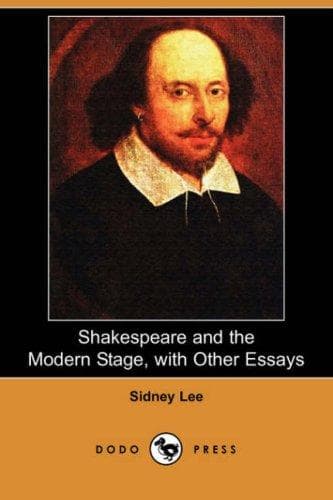
Shakespeare and the Modern Stage; with Other EssaysLee, Sidney, Sir
History
Shakespeare and the Modern Stage; with Other Essays
Lee, Sidney, Sir
Shakespeare, William, 1564-1616; Shakespeare, William, 1564-1616 -- Stage history
_Hamlet_ was one of the most popular plays of Pepys's day, mainly
owing to Betterton's extraordinary faculty. The history of the
impersonation presents numerous points of the deepest interest. The
actor was originally coached in the part by D'Avenant. The latter is
said to have derived hints for the rendering from an old actor, Joseph
Taylor, who had played the role in Shakespeare's own day, and had been
instructed in it by the dramatist himself. This tradition gives
additional value to Pepys's musical setting in recitative of the "To
be or not to be" soliloquy. If we accept the reasonable theory that
that piece of music preserves something of the cadences of Betterton's
enunciation, it is no extravagance to suggest that a note here or
there enshrines the modulation of the voice of Shakespeare himself.
For there is the likelihood that the dramatist was Betterton's
instructor at no more than two removes. Only the lips of D'Avenant,
Shakespeare's godson, and of Taylor, Shakespeare's acting colleague,
intervened between the dramatist and the Hamlet of Pepys's diary.
Those alone, who have heard the musical setting of "To be or not to
be" adequately rendered, are in a position to reject this hypothesis
altogether.
Among seventeenth century critics there was unanimous agreement--a
rare thing among dramatic critics of any period--as to the merits of
Betterton's performance. In regard to his supreme excellence, men of
the different mental calibre of Sir Richard Steele, Colley Cibber, and
Nicholas Rowe, knew no difference of opinion. According to Cibber,
Betterton invariably preserved the happy "medium between mouthing and
meaning too little"; he held the attention of the audience by "a
tempered spirit," not by mere vehemence of voice. His solemn,
trembling voice made the Ghost equally terrible to the spectator and
to himself. Another critic relates that when Betterton's Hamlet saw
the Ghost in his mother's chamber, the actor turned as pale as his
neckcloth; every joint of his body seemed to be affected with a tremor
inexpressible, and the audience shared his astonishment and horror.
Nicholas Rowe declared that "Betterton performed the part as if it had
been written on purpose for him, as if the author had conceived it as
he played it." It is difficult to imagine any loftier commendation of
a Shakespearean player.
V
Public-domain text, read in full here on John Shaqi.
Reviews
Reviews
No reviews yet
Be the first to share your thoughts on this work.
Elsewhere in the archive
Join the Discussion
Join the discussion
Sign in to leave a comment or review.
Sign InorCreate an account