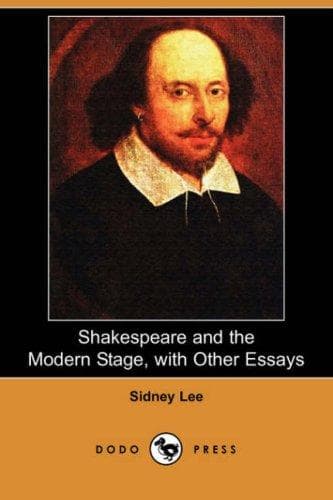
Shakespeare and the Modern Stage; with Other EssaysLee, Sidney, Sir
History
Shakespeare and the Modern Stage; with Other Essays
Lee, Sidney, Sir
Shakespeare, William, 1564-1616; Shakespeare, William, 1564-1616 -- Stage history
The other mention of Aristotle is in _Troilus and Cressida_, and
raises points of greater interest. Hector scornfully likens his
brothers Troilus and Paris, when they urge persistence in the strife
with Greece, to "young men whom Aristotle thought unfit to hear
_moral_ philosophy" (II., ii., 166). The words present the meaning,
but not the language, of a sentence in Aristotle's "Nicomachean
Ethics" (i. 8). Aristotle there declares passionate youth to be
unfitted to study _political_ philosophy; he makes no mention of
_moral_ philosophy. The change of epithet does, however, no injustice
to Aristotle's argument. His context makes it plain, that by
_political_ philosophy he means the ethics of civil society, which
are hardly distinguishable from what is commonly called "morals." The
maxim, in the slightly irregular shape which Shakespeare adopted,
enjoyed proverbial currency before the dramatist was born. Erasmus
introduced it in this form into his far-famed _Colloquies_. In France
and Italy the warning against instructing youth in _moral_ philosophy
was popularly accepted as an Aristotelian injunction. Sceptics about
the obvious Shakespearean tradition have made much of the circumstance
that Bacon, who cited the aphorism from Aristotle in his _Advancement
of Learning_, substituted, like Shakespeare in _Troilus and Cressida_,
the epithet "moral" for "political." The proverbial currency of the
emendation deprives the coincidence of point.
The repetition of a proverbial phrase, indirectly drawn from
Aristotle, combined with the absence of other references to the Greek
philosopher, renders improbable Shakespeare's personal acquaintance
with his work. In any case, the bare mention of the name of Aristotle
implies nothing in this connection. It was a popular synonym for
ancient learning. It was as often on the lips of Elizabethans as
Bacon's name is on the lips of men and women of to-day, and it would
be rash to infer that those who carelessly and casually mentioned
Bacon's name to-day knew his writings or philosophic theories at first
hand.
No evidence is forthcoming that Shakespeare knew in any solid sense
aught of philosophy of the formal scientific kind. On scientific
philosophy, and on natural science, Shakespeare probably looked with
suspicion. He expressed no high opinion of astronomers, who pursue
the most imposing of all branches of scientific speculation.
Small have continual plodders ever won,
Save base authority from others' books.
These earthly godfathers of heaven's light,
That give a name to every fixed star,
Have no more profit of their shining nights
Than those that walk, and wot not what they are.
(_Love's Labour's Lost_, I., i., 86-91.)
Public-domain text, read in full here on John Shaqi.
Reviews
Reviews
No reviews yet
Be the first to share your thoughts on this work.
Elsewhere in the archive
Join the Discussion
Join the discussion
Sign in to leave a comment or review.
Sign InorCreate an account