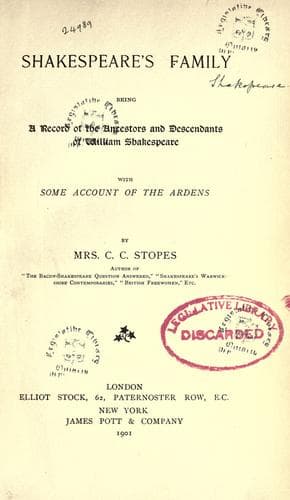
Shakespeare's familyStopes, C. C. (Charlotte Carmichael)
History
Shakespeare's family
Stopes, C. C. (Charlotte Carmichael)
Arden family; Shakespeare family; Shakespeare, William, 1564-1616 -- Family
Now, this apparently second sale has puzzled many Shakespeareans, as
well as the "fraction." Even Halliwell-Phillipps[108] supposes that
"John Shakespeare had some small interest in Snitterfield of his own,"
which he parted with for L4, and that "Mary Shakespeare was entitled
to a share through an earlier settlement." Others have thought, however,
that the first was but a draught deed of the indenture, the L4 the
earnest money, and the "final concord" for L40 the conclusion of the
whole. This is supported by the absolute indefiniteness of the first as
to part or parts in two messuages, and by the apparent definiteness of
the second. But the peculiar wording has further puzzled many writers.
In referring to Robert Arden's settlements, we find that one tenement is
settled upon three daughters, and the other tenement settled upon other
three daughters, Mary's name not being mentioned. How, then, was she
empowered to sell any share? It could only be by inheritance or by gift
from some of her other sisters. The course of events showed it was not
of free gift. But Joyce and Alice had apparently vanished from the
scene. If they left no will, their shares would be divisible into equal
parts among their surviving sisters by common law, and through her
fraction of their shares Mary Shakespeare could step in as part owner of
Snitterfield. Now, it is quite possible that the first sale of 1579 was
an indefinite sale of Mary's share of Joyce's portion; and it is
possible that Alice died in that year, and increased the share of her
sisters, so that the two portions were treated together in the deed of
1580. Seeing that the two portions of the property had long been held
together by the Webbes, it is quite natural to read "the sixth part of
two" rather than "the third of one," as each sister originally read her
share. Now, if Mary had lost both of her sisters, it is quite natural to
read her share as "the sixth part of two _parts_ or portions of two
tenements." This has not yet been thus simply explained. But it is not
strictly correct; for while the share of the first sister would bring
Mary "the sixth part of one part of two tenements," the death of the
second sister should have secured her the _fifth part_ of one part of
two tenements, plus the fraction already inherited by the second from
the first, or, more simply, the fifth part of two parts of two
tenements. It was near enough, however, for all practical purposes, and
Robert Webbe seems duly to have handed over the money to John
Shakespeare. Robert Webbe's eagerness to buy, and the Shakespeares' need
of the money, seems to have determined the price. Forty pounds was a
large sum for such a fraction of the whole. Robert Webbe's readiness may
be accounted for, because he was on the eve of marriage. There was a new
settlement[109] of estates at Snitterfield on the occasion of his
marriage to Mary, daughter of John Perkes, September 1, 23 Elizabeth,
Public-domain text, read in full here on John Shaqi.
Reviews
Reviews
No reviews yet
Be the first to share your thoughts on this work.
Join the Discussion
Join the discussion
Sign in to leave a comment or review.
Sign InorCreate an account