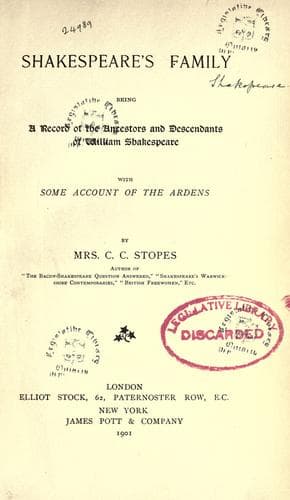
Shakespeare's familyStopes, C. C. (Charlotte Carmichael)
History
Shakespeare's family
Stopes, C. C. (Charlotte Carmichael)
Arden family; Shakespeare family; Shakespeare, William, 1564-1616 -- Family
and an agreement between Edward Cornwall[110] (stepfather to Robert
Webbe) and William Perkes, respecting an estate in Snitterfield, and a
proviso against any claim from the Ardens.
But it was not from the Ardens that any difficulty arose. Before the
death of Mrs. Agnes Arden, she was called to support her claim and that
of all her stepdaughters, based on a supposition of entail, against the
descendants of the Mayowe who had sold his property to Thomas and Robert
Arden in 1501. Being described as old and infirm, a Commission was
directed to Bartholomew Hales, Lord of the Manor of Snitterfield, and
Nicholas Knolles, Vicar of Alveston, to take her deposition concerning
it, in July, 1580.[111] She died in December of that year; and in 1582
John Shakespeare,[112] and his brother Henry, and Adam Palmer, with
others, were called on to give evidence in the case between Thomas
Mayowe and Robert Webbe, before Sir Fulk Grevyle, Sir Thomas Lucy,
Humphrey Peto, and William Clopton, Commissioners. Their depositions in
support of the deed of transfer seem to have been sufficient, and we
hear no more of Mayowe. The newly-married couple settled down on the
inheritance of the Ardens, and the old home of the Shakespeares.
Concerning Mary Arden's special inheritance at Asbies, there is a sadder
story to tell. Whether John Shakespeare could read or not, he was
certainly not a Latin scholar, and though not ignorant of many points of
common law, was not up to all the technicalities used at times to
confuse the truth. It is evident that there had been some verbal
agreement between him and Edmund Lambert on which he relied, but that
the written deed was all that John Lambert accepted.[113] On selling the
main portion of his wife's property at Snitterfield, John Shakespeare
seems to have walked right off with the money to Edmund Lambert, of
Barton-on-the-Heath, to redeem his mortgage, and reinstate himself as
owner of Asbies, free to grant a lease or sale on his own terms. But
through a quibble, which "was not in the bond," Edmund Lambert refused
to accept this until certain other debts were also paid. Thereby he
gained the shelter of time, which "was in the bond," and put Shakespeare
at a legal disadvantage, though it is evident from the later papers that
a verbal agreement had taken place to extend the time, seeing that the
money had been tendered. We may be sure that the property was worth more
than L40 in hard cash to either, and more, in romantic associations, to
the Shakespeares. For it was a part of Thomas Arden's original property.
How he came by it, no one is sure. French[114] suggests it might have
been given him by the Beauchamps of Bergavenny, who had intermarried
with the Ardens, and had been more than once known to have been in
friendly relations. The guardian of Robert Arden, his grandfather, had
been the Lady of Bergavenny, and Elizabeth Beauchamp was godmother to
Elizabeth Arden, daughter of Walter and sister of Thomas, whom we take
Public-domain text, read in full here on John Shaqi.
Reviews
Reviews
No reviews yet
Be the first to share your thoughts on this work.
Join the Discussion
Join the discussion
Sign in to leave a comment or review.
Sign InorCreate an account