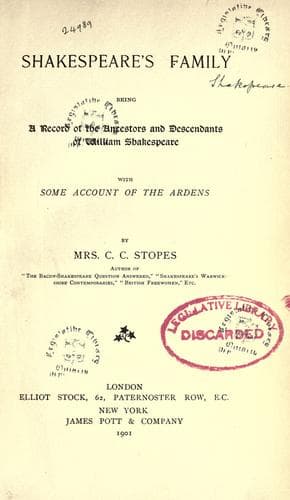
Shakespeare's familyStopes, C. C. (Charlotte Carmichael)
History
Shakespeare's family
Stopes, C. C. (Charlotte Carmichael)
Arden family; Shakespeare family; Shakespeare, William, 1564-1616 -- Family
It is evident that Shakespeare had at some time or other associated
himself with Burbage's company. Now, James Burbage, "was the first
builder of playhouses" who had planned in 1576, and in spite of evil
report and professional rivalry, of municipal and royal restrictions,
legal and other expenses, had successfully carried on "The Theatre" in
Finsbury Fields. In 1596 he had purchased the house in Blackfriars,
against the use of which as a theatre was sent up to the Privy Council a
petition, which Richard Field signed.[153] The Burbages let this house
for a time to a company of "children," but eventually resumed it for
their own use, and in it placed "men-players, which were Hemings,
Condell, Shakespeare," etc. On Burbage's death in 1597, there was a
dispute about "The Theater" lease, and his sons transferred the
materials to Southwark, and built the Globe in 1599. On the rearing of
the Globe at heavy cost, they joined to themselves "those deserving men
Shakespeare, Hemings, Condell, Philips and others, partners in the
Profits of what they call the House, but making the leases for
twenty-one years hath been the destruction of ourselves and others, for
they, dying at the expiration of three or four years of their lease, the
subsequent yeares became dissolved to strangers, as by marrying with
theire widdowes, and the like by their children." (See the papers
concerning the shares in the Globe, 1535: 1. Petition of Benfield,
Swanston and Pollard to the Lord Chamberlain Pembroke (April). 2. A
further petition. 3. The answer of Shank. 4. The answer of C. Burbage,
Winifred, his brother's widow, and William his son. 5. Pembroke's
judgment thereon (July 12). 6. Shanke's petition (August 7). 7.
Pembroke's final decision.)[154]
Burbage, Shakespeare, Condell, Hemings had been housekeepers with four
shares each. These originally died with the owner, but in later years
could be inherited. Shakespeare's income therefore arose from:
1. Possibly some small sum allowed him by Richard Field and the
publishers for various editions of his poems, as well as the liberality
of the Earl of Southampton on their account.
2. Direct payments by the proprietors for altering and writing plays.
Shares in their publication he never seems to have had.
3. His share as a player of the money taken at the doors.
4. His share as a partner in the house of the money taken in the
galleries, etc.
5. His share of royal largesse in performances before the Queen, or
similar gifts from noblemen.[155]
6. His share of performances in various performing tours.
Public-domain text, read in full here on John Shaqi.
Reviews
Reviews
No reviews yet
Be the first to share your thoughts on this work.
Join the Discussion
Join the discussion
Sign in to leave a comment or review.
Sign InorCreate an account