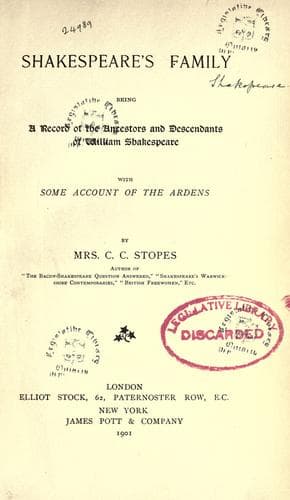
Shakespeare's familyStopes, C. C. (Charlotte Carmichael)
History
Shakespeare's family
Stopes, C. C. (Charlotte Carmichael)
Arden family; Shakespeare family; Shakespeare, William, 1564-1616 -- Family
And thence he acquired money enough to buy New Place; to appeal to the
heralds for his father's coat of arms, and to pay the costs; to contest
the Lamberts' claim through successive applications for Asbies; and to
buy land and tithe leases. The death of his only son Hamnet did not
deter him in his earnest efforts to regain social position, and to
restore the fortunes of his family. An almost exact parallel may be
found in the efforts and aims of Sir Walter Scott. But Shakespeare,
having borne the yoke in youth, had acquired the experience and prudence
necessary to steer himself past the dangers of speculation and the
rashness of exceeding his assured income, which proved fatal to the less
severely-trained novelist.
In May, 1602, he purchased from the Combes for L320 about 107 acres of
land near Stratford-on-Avon, of which, as he was not in the town, seisin
was granted to his brother Gilbert. On September 28, 1602, Walter Getley
transferred to him a cottage and garden situated in Chapel Lane,
opposite the lower gardens of New Place, quite possibly intended for the
use of his brothers. It appears from the roll that he did not appear at
the Manorial Court in person,[156] then held at Rowington, there being a
stipulation that the estate should remain in the hands of the lady of
the manor, the Countess of Warwick, until he appeared to complete the
transaction with the usual formalities. On completing these, he
surrendered the property to his own use for life, with remainder to his
two daughters, a settlement rearranged afterwards in his will. It is
mentioned as in his possession in a subsequent subsidy roll of the
town.[157]
The only time in which he touched politics and State affairs he was
unfortunate. There is no doubt he must have trembled at the time of the
Essex Conspiracy, not only for his friend Southampton's life, but even
for his own; for Philips, the manager of his company, was called before
the Privy Council to account for the performances of the obnoxious play
of "Richard II."
The danger passed. Probably the Privy Council thought it futile to
attack the "Puppets." Nevertheless, after fulfilling their engagements
they hastened from the Metropolis.[158] Some of his company went to play
in Scotland, as far north as Aberdeen.[159] I am inclined to think
Shakespeare went with them. The scenery in "Macbeth"[160] suggests vivid
visual impressions, and the favour of James VI. must have been secured
_before_ his accession to the throne of England, for almost the first
act the King did on his arrival at the Metropolis, May 7, 1603, was to
execute a series of Acts that practically gave his company a monopoly.
"Pat. I., Jac. I., p. 2, m. 4. Pro Laurentio Fletcher et
Willielmo Shakespeare et aliis.[161]
Public-domain text, read in full here on John Shaqi.
Reviews
Reviews
No reviews yet
Be the first to share your thoughts on this work.
Join the Discussion
Join the discussion
Sign in to leave a comment or review.
Sign InorCreate an account