Law in literature; Shakespeare, William, 1564-1616 -- Knowledge -- Law
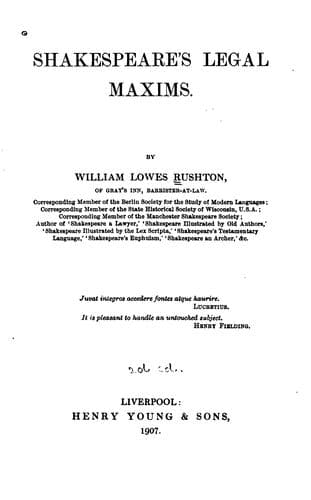
SHAKESPEARE’S LEGAL MAXIMS.
SHAKESPEARE’S LEGAL
MAXIMS.
BY
WILLIAM LOWES RUSHTON,
OF GRAY’S INN, BARRISTER-AT-LAW.
Corresponding Member of the Berlin Society for the Study of
Modern Languages; Corresponding Member of the State Historical
Society of Wisconsin, U.S.A.; Corresponding Member of the
Manchester Shakespeare Society; Author of ‘Shakespeare a
Lawyer,’ ‘Shakespeare Illustrated by Old Authors,’
‘Shakespeare Illustrated by the Lex Scripta,’
‘Shakespeare’s Testamentary Language,’
‘Shakespeare’s Euphuism,’ ‘Shakespeare
an Archer,’ &c.
_Juvat integros accedere fontes atque haurire._
LUCRETIUS.
_It is pleasant to handle an untouched subject._
HENRY FIELDING.
LIVERPOOL:
HENRY YOUNG & SONS,
1907.
NOTICE.
The first edition of this attempt to illustrate obscure passages in
the works of William Shakespeare by legal maxims was published when I
was a student-at-law. It was sent to the press for review, and some of
the London papers referred to it as a second edition of ‘Shakespeare a
Lawyer.’ The only notice I saw of it appeared in the _Liverpool Albion_
as follows:—
‘Not very long since, Mr. Rushton published a pamphlet, “Shakespeare
a Lawyer,” which attracted considerable attention in the literary
and theatrical world. It is well known that Lord Campbell, some time
afterwards, published a similar work, availing himself, without
acknowledgment, of Mr. Rushton’s labours, as the _Examiner_ conclusively
pointed out. Like its predecessor, this brochure shows the author is
deeply read in law.’
On page 100 of ‘William Shakespeare’ by Karl Elze, published in Germany
in 1876, the following may be seen:—
‘Lord Campbell, “Shakespeare’s Legal Acquirements,” London, 1859—Vergl.
ausserdem W. L. Rushton, “Shakespeare a Lawyer,” London, 1858. Rushton
ist schon vor Lord Campbell zu dem gleichen Ergebnisse gekommen wie
dieser, wenngleich sich seine Schrift im Uebrigen nicht mit der des
letztern messen kann. Beachtung verdienen jedoch Rushton’s Erklärungen
der einschlagenden Stellen bei Shakespeare.’
German students of Shakespeare, who are induced by this note to refer
to Lord Campbell’s ‘Shakespeare’s Legal Acquirements Considered’ for
accurate explanations of the law and law terms they meet with in
Shakespeare’s works, will often be misinformed, because that book
contains many mistakes in law.
Public-domain text, read in full here on John Shaqi.
Reviews
Reviews
No reviews yet
Be the first to share your thoughts on this work.
Join the Discussion
Join the discussion
Sign in to leave a comment or review.
Sign InorCreate an account