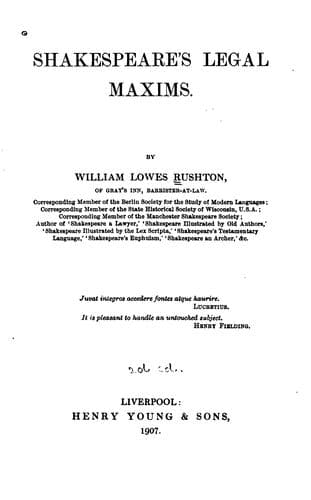
Law in literature; Shakespeare, William, 1564-1616 -- Knowledge -- Law
Bacon, in his ‘Legal Maxims,’ says, ‘It might have been more flourish and
ostentation of reading to have vouched the authorities and sometimes to
have enforced or noted them; yet I have abstained from that also, and
the reason is, because I judged it a matter undue and preposterous to
prove rules and maxims.’ I should have saved myself some trouble if I had
‘abstained from the flourish and ostentation’ of vouching my authorities.
In the plays of Ben Jonson, George Chapman, and other dramatists of their
time, legal maxims are to be seen in Latin. Shakespeare never quotes
legal maxims in Latin, but he gives correct translations of them which
are so embodied in his verse and prose that they have not the appearance
of quotations. This may be one of the reasons why they have not been
noticed by the commentators. Another reason may be that the commentators
who were not members of the legal profession did not recognise them
because they were ignorant of law, and the commentators who were lawyers
did not recognise them because they were ignorant of Shakespeare.
Shakespeare’s correct translations of legal maxims are, I think, the only
satisfactory evidence we have of his knowledge of Latin.
I now give one example of Shakespeare’s correct translations of the Latin
maxims, and of the good verse he makes of it.
Dormiunt aliquando leges moriuntur nunquam.
The law hath not been dead, though it hath slept.
where the verbs dormio and morior in Latin are represented correctly
by the verbs sleep and die in English. Although Bacon’s legal maxims
are twenty-five in number I have not found any of them in Shakespeare’s
plays, but a portion of one of them[1]—Sententia definitiva, revocari non
potest, as I venture to put it—expresses the law to which Shakespeare
refers in the _Comedy of Errors_.
_Duke._ But, though thou art adjudged to the death,
And _passed sentence cannot be recall’d_
But to our honour’s great disparagement,
Yet will I favour thee in what I can.
_Comedy of Errors_, Act i. Scene 1.
Those who believe that Francis Bacon wrote the plays attributed to
William Shakespeare may think that this statement is worthy of
consideration.
Some commentators have concluded that Shakespeare was not a lawyer
because, as they say, he has made mistakes in law. In answer to this
conclusion, I ask three questions.
1. Is there a barrister or a solicitor in large practice, or a judge on
the bench, who can say with truth, ‘I never made a mistake in law’?
Seldom sits the judge that may not err.
_Partheniades._
2. Why have we a Court of Appeal?
3. Was it established to confirm or reverse the judgments and decisions
of men who were _not_ lawyers?
Public-domain text, read in full here on John Shaqi.
Reviews
Reviews
No reviews yet
Be the first to share your thoughts on this work.
Join the Discussion
Join the discussion
Sign in to leave a comment or review.
Sign InorCreate an account