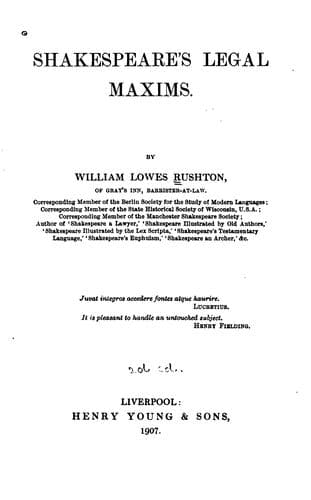
Law in literature; Shakespeare, William, 1564-1616 -- Knowledge -- Law
If the act be unlawful it is murder. As if A, meaning to steal a deer
in the park of B, shooteth at the deer, and by a glance of the arrow,
killeth a boy that is hidden in a bush, this is murder; for that the act
was unlawful, although A had not intent to hurt the boy, nor knew not
of him. Thus if B, the owner of the park, had shot at his own deer, and
without any ill intent had killed the boy by the glance of his arrow,
this had been homicide by misadventure, and no felony. So if one shoot at
any wild fowl upon a tree, and the arrow killeth any reasonable creature
afar off, without any evil intent in him, this is per infortunium,
for it was not unlawful to shoot at the wild fowl; but if he had shot
at a cock or a hen, or any tame fowl of another man’s, and the arrow
by mischance had killed a man, this had been murder, for the act was
unlawful. If a man, knowing that many people came in the street from a
sermon, threw a stone over a wall, intending only to fear them or to give
them a light hurt, and thereupon one is killed, this is murder; for he
had an ill intent, though that intent extended not to death, and though
he knew not the party slain (Marlbr. c. 25; 3 Inst. 56, 57). All crimes
have their conception in a corrupt intent, have their consummation and
issuing in some particular fact, which, though it be not the fact at
which the intention of the malefactor levelled, yet the law giveth him no
advantage of the error, if another particular ensue of as high a nature.
As if A, having malice to B, strikes at him and misseth him and kills
C, this is murder in A (9 Rep. 81; H. P. C. 50). So Bracton says, ‘Si
quis unum percusserit, cum aliam percutere vellet, in felonia tenetur’
(lib. 3, fol. 155). And if one lays poison to kill B, and C takes it and
dies in consequence, this is murder in him that laid the poison: for,
In criminalibus sufficit generalis malitia intentionis cum facto paris
gradus (Bacon, Max., 65). The malice intended to one makes the accidental
death of another to be murder (Wood’s Inst., 2nd ed., 353).
_Hub._ Stand back, Lord Salisbury, stand back I say:
By heaven, I think my sword’s as sharp as yours:
I would not have you, lord, forget yourself,
Nor tempt the danger of my true defence;
Lest I, by marking of your rage, forget
Your worth, your greatness, and nobility.
_Big._ Out, dunghill! dar’st thou brave a nobleman?
_Hub._ Not for my life: but yet I dare defend
My innocent life against an emperor.
_King John_, Act iv. Scene 3.
Excusable homicide is se defendendo, or where one has no other possible
means of preserving his own life than by killing the person who
reduces him to such a necessity, for, Vim vi repellere licet, modo
fiat moderamine inculpatæ tutelæ, non ad sumendam vindictam, sed ad
propulsandam injuriam (I. Inst. 162a; Wood’s Inst., 2nd ed., 359).
Public-domain text, read in full here on John Shaqi.
Reviews
Reviews
No reviews yet
Be the first to share your thoughts on this work.
Join the Discussion
Join the discussion
Sign in to leave a comment or review.
Sign InorCreate an account