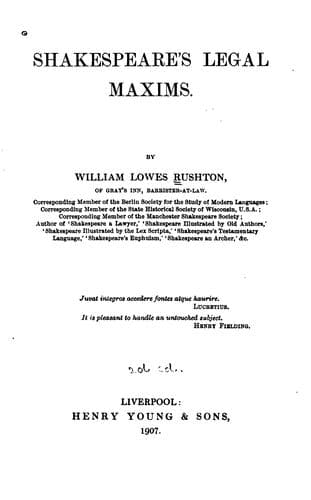
Law in literature; Shakespeare, William, 1564-1616 -- Knowledge -- Law
In all crimes there must be an evil disposition; a mere mistake is not
punishable; and those that are to be esteemed guilty of any offences must
have the use of their reason, and be at their own disposal or liberty
(Wood’s Inst., 2nd ed., p. 340, 339), for, Actus non facit reum nisi mens
sit rea (3 Inst. 107), the act does not make a man guilty unless his
intention were guilty. Moreover Hamlet says—
Who does it then? His madness: if’t be so,
Hamlet is of the faction that is wrong’d;
His madness is poor Hamlet’s enemy.
And in criminal cases idiots and lunatics are not chargeable for their
own acts, if committed at a time when they are non compos mentis, for it
is a maxim of the law of England that Furiosus solo furore puniatur, a
madman is only punished by his madness (Co. Litt. 247b; Bal. Com., 24,
25). So Hamlet says he is of the faction that is wronged, and he seems
to refer, not only to the maxim that the act does not make a man guilty
unless his intentions were guilty, but afterwards, in the same passage,
to the kind of homicide to which it is applicable—
Sir, in this audience,
Let my disclaiming from a purpos’d evil
Free me so far in your most generous thoughts,
That I have shot mine arrow o’er the house,
And hurt my brother.
viz., homicide per infortunium, or by misadventure,[2] which is, where a
man doing a lawful act, without any intention of hurt, by accident kills
another; as, for instance, where a man is working with a hatchet, and
the head flies off and kills a bystander. So Bracton says, ‘De amputatore
arborum, qui cum ramum projiceret, inscius occidit transeuntem, aut
cum quis pilam percusserit, &c., ex cujus ictu occisus est, tales de
homicidio non tenentur’ (lib. 3, fo. 136b). If a man shooting at butts
or a target, by accident kills a bystander, it is misadventure (I. Hale,
472, 475, 380), but this must be understood of cases where a proper
precaution to prevent accidents has been taken, for if the target be
placed near a highway or path, where persons are in the habit of passing,
the killing would probably be deemed manslaughter.
_Camillo._ Have you thought on
A place whereto you’ll go?
_Florizel._ Not any yet:
But as th’ _unthought-on accident is guilty_
_To what we wildly do_, so we profess
Ourselves to be the slaves of chance, and flies
Of every wind that blows.
_Winter’s Tale_, Act iv. Scene 4.
Public-domain text, read in full here on John Shaqi.
Reviews
Reviews
No reviews yet
Be the first to share your thoughts on this work.
Join the Discussion
Join the discussion
Sign in to leave a comment or review.
Sign InorCreate an account