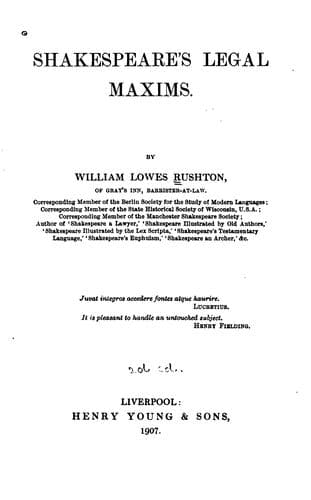
Law in literature; Shakespeare, William, 1564-1616 -- Knowledge -- Law
It seems that Shakespeare has made the first clown confound a felo de se,
or one who is guilty of self murder, with a person who commits homicide
se defendendo, in his own defence, or, as he miscalls it, se offendendo;
for, in answer to the second clown’s assurance that ‘the crowner hath
sate on her and finds it Christian burial,’ he says, ‘How can that be,
unless she drowned herself in _her own defence_?’ This is also apparent
from his reasoning, which, although it may appear absurd, is good law;
for he evidently means, that if the water comes to a man and drowns
him, not wittingly, but against his inclination, he is as innocent of
suicide as that man is innocent of murder, who, se defendendo, in his own
defence, kills another who, felleo animo, presses upon him. And so the
crowner found it ‘Christian burial;’ for although the ‘churlish priest’
tells Laertes that ‘her death was doubtful,’ yet the queen says—
There, on the pendent boughs her coronet weeds
Clambering to hang, an envious sliver broke;
When down her weedy trophies, and herself,
Fell in the weeping brook.
And although, according to this account, the water cannot be said to come
to Ophelia, it appears that she was drowned, not ‘wittingly,’ but against
her inclination. Suicides were not entitled to what is called ‘Christian
burial,’ for it was formerly the custom to drive a stake through the body
of one who had been guilty of self-murder, and to bury it in the highway;
but this brutal law and ignominious burial has been altered by the 4 Geo.
IV. c. 52, which directs that a person felo de se shall be buried without
any stake driven through the body, privately in a churchyard, within
twenty-four hours from the finding of the inquisition, and between the
hours of nine and twelve at night; but this statute does not authorise
the performance of the rites of burial.
_Ch. Just._ I then did use the person of your father,
The image of his power lay then in me:
And, in the administration of his law,
Whiles I was busy for the commonwealth,
Your highness pleased to forget my place,
The majesty and power of law and justice,
The image of the king whom I presented,
And struck me _in my very seat of judgment_;
Whereon, as an offender to your father,
I gave bold way to my authority,
And did commit you.
_2 Henry IV._, Act v. Scene 2.
Injuria illata judici, seu locum tenenti regis, videtur ipsi regi illata,
maxime si fiat in exercentem officium (3 Inst. 1).
Public-domain text, read in full here on John Shaqi.
Reviews
Reviews
No reviews yet
Be the first to share your thoughts on this work.
Join the Discussion
Join the discussion
Sign in to leave a comment or review.
Sign InorCreate an account