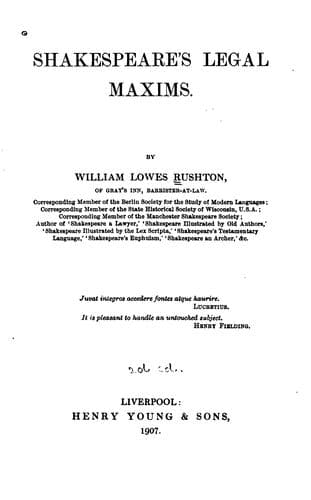
Law in literature; Shakespeare, William, 1564-1616 -- Knowledge -- Law
Shakespeare in this passage probably refers to this maxim, or to the law
which it describes. The Chief Justice says, ‘When I did use the person of
your father, &c., you struck me in my very judgment seat, whereon as an
offender to your father I did commit you,’ and according to this maxim,
an injury offered to a judge, or one holding the place of the king, is
considered to be offered to the king himself, especially if done in
exercise of the office of a judge.
In the first part of ‘Shakespeare Illustrated by Old Authors,’ published
in the year 1867, I quoted this maxim in illustration of this passage,
beginning my comment with these words: ‘Shakespeare in this passage
probably _refers to this maxim or the law which it describes_.’ The
author of a book entitled ‘Shakespeare as a Lawyer’ quotes this passage
and this maxim after saying, ‘Shakespeare, in the following passage from
the second part of _Henry IV._, _refers to this maxim or to the law
which it describes_,’ using the initial words of my comment. Without
this explanation those who have read ‘Shakespeare as a Lawyer,’ and have
not seen ‘Shakespeare Illustrated by Old Authors,’ may suppose that
I, instead of originating this illustration, had adopted it without
acknowledgment.
This method of appropriation and concealment extends to other books of
mine. I give one more example of many. In ‘Shakespeare’s Euphuism,’
published in 1871, I showed that the advice of Euphues to Philatus was
probably the origin of the advice of Polonius to Laertes, but a few years
ago a ‘Life of Shakespeare’ was published by Smith, Elder and Co., in
which are these words—‘In later life, Shakespeare in _Hamlet_ borrows
from Lyly’s “Euphues” Polonius’s advice to Laertes,’ and this statement
is made without mentioning my name or my book, from which the information
was obtained. This and much more inclines me to say with Falstaff—
I would to God my name were not so terrible to the enemy as it
is.
_2 Henry IV._, Act i. Scene 2.
Puttenham in his ‘Second Book of Proportion Poetical,’ speaking of device
or emblem, says—
‘The Greeks call it Emblema, the Italians Impresa, and we, a
Device, such as a man may put into letters of gold and send
to his mistresses for a token, or cause to be embroidered in
Scutchions of arms on any bordure of a rich garment, to give by
his novelty marvel to the beholder.’
To this impresa Shakespeare refers in _Richard II._, when Bolingbroke,
addressing Bushby and Green, says—
You have fed upon my signories,
Dispark’d my parks and fell’d my forest woods,
From my own windows torn my household coat,
Razed out my _imprese_, leaving me no sign,
Save men’s opinions and my living blood,
To show the world I am a gentleman.
_Richard II._, Act iii. Scene 1.
Public-domain text, read in full here on John Shaqi.
Reviews
Reviews
No reviews yet
Be the first to share your thoughts on this work.
Join the Discussion
Join the discussion
Sign in to leave a comment or review.
Sign InorCreate an account