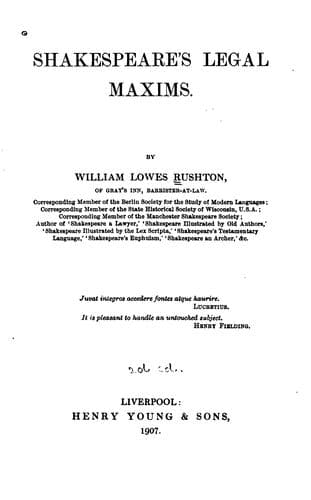
Law in literature; Shakespeare, William, 1564-1616 -- Knowledge -- Law
‘If the Bishop makes a certificate, and dies before it is received, it
is nothing worth, but his successor ought to certify it (F. N. B. 65,
8 E. 2, Excom. 26, 14 E. 3; ibid. 8). But note, reader, that in some
cases the Vicar-general may certify an excommengement, that is when the
Bishop is in remotis agendis, which is as much as to say, extra regnum,
in the king’s service; but the Court will be apprized of it by matter of
record, scil. by writ out of the Chancery directed to them, and not by
the surmise of the party, and then for necessity (which is always the
law of time, for necessitas est lex temporis) the certificate of the
Vicar-general shall be allowed, because no other can make it’ (Co. Rep.
viii. 69). In excuse for his going away Antony mentions the necessity of
time, and it was the necessity of time which required and rendered valid
the certificate of the Vicar-general.
* * * * *
In the books mentioned on the title-page of this small volume, in my
contributions to the Berlin Society for the Study of Modern Languages,
published in Archiv. f. n. Sprachen, and in _Notes and Queries_, I have
called attention to Shakespeare’s knowledge of old law books, of the
Real Property Law, the Common Law and the Lex Scripta, but I think the
knowledge and correct application of legal maxims displayed in his works
afford the strongest evidence I have yet produced that the great poet
must have been, for some time, a student-at-law.
THE END
Printed by BALLANTYNE, HANSON & CO.
Edinburgh & London
FOOTNOTES
[1] Sententia interlocutoria revocare potest, definitiva non potest.
[2] Homicide (from the Latin homicidium; homo, a man, and cido, to strike,
kill) signifies the killing of a human creature, and it is of three kinds,
justifiable, excusable, and felonious.
_ERRATA._
Transcriber’s Note: The errata have been corrected.
Page 10, Line 13, _for_ Revocare _read_ Revocari
” 18, ” 14, ” Leges ” Legis.
” 25, ” 10, ” Ædificio ” Ædifico.
” 31, ” 13, ” Jurator ” Juratore.
” 33, ” 9, ” Debit ” Debit’
” 36, ” 9, ” Jussa ” Jussu.
” 38, ” 26, ” Cogitationes ” Cogitationis.
” 38, ” 14, ” Hood’s ” Wood’s.
” 42, ” 4, ” Rarmun ” Ramum.
” 44, ” 9, ” Eum aliam ” Cum alium.
” 52, ” 24, ” Quid ” Quia.
” 53, ” 21, ” Civitus ” Civitas.
” 54, ” 23, ” Debet ” Debent.
” 54, ” 24, ” Continum ” Continuum.
” 56, ” 13, ” Et ” Ex.
” 56, ” 14, ” Justa ” Juxta.
Public-domain text, read in full here on John Shaqi.
Reviews
Reviews
No reviews yet
Be the first to share your thoughts on this work.
Join the Discussion
Join the discussion
Sign in to leave a comment or review.
Sign InorCreate an account