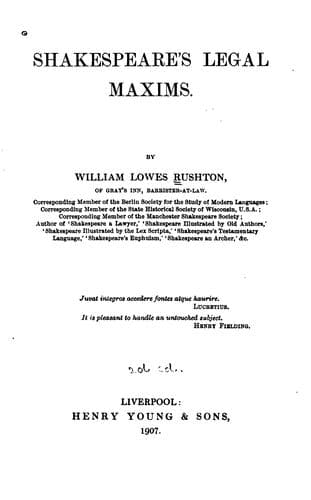
Law in literature; Shakespeare, William, 1564-1616 -- Knowledge -- Law
_Richard._ God save the King! Will no man say amen?
Am I both _priest_ and _clerk_? Well then, amen.
_King Richard II._, Act iv. Scene 1.
Shakespeare may here refer to two legal maxims, for one says, Rex est
persona sacra et mixta cum sacerdote (5 Co. Eccl. L), and the other says,
Reges dicuntur clerici (Dav. 4).
_Lady Macbeth._ Alack, I am afraid they have awaked
And ’tis not done. The attempt and not the deed
Confounds us.
_Macbeth_, Act ii. Scene 2.
Non officit _conatus_ nisi sequatur _effectus_ (11 Co. 98). _Attempt_ is
the English of conatus, and _deed_ may represent effectus.
_Scici._ He shall be thrown down the Tarpeian rock
With rigorous hands; he hath resisted law,
And therefore law shall scorn him any further trial
Than the severity of the public power,
Which he so sets at nought.
_Coriolanus_, Act iii. Scene 1.
Merito beneficium legis amittit, qui legem ipsam subvertere intendit
(2 Inst. 53). According to Scicinius, Coriolanus had resisted law and
therefore lost the benefit of the law.
_Sal._ May this be possible? may this be true?
_Mel._ Have I not hideous death within my view,
Retaining but a quantity of life,
Which bleeds away, even as a form of wax
Resolveth from his figure ’gainst the fire?
What in the world should make me now deceive,
Since I must lose the use of all deceit?
Why should I, then, be false, since it is true
That I must die here, and live hence by truth?
_King John_, Act v. Scene 4.
Nemo præsumitur esse immemor suæ æternæ salutis, et maxime in articulo
mortis (6 Co. 76).
Melun was in articulo mortis, and according to this maxim no one is
presumed to be unmindful of his eternal welfare, and especially at the
point of death.
_Diana._ ’Tis not the many oaths that make the truth,
But the plain single vow, that is vow’d true.
What is not holy, that we swear not by,
But _take the Highest to witness_.
_All’s Well That Ends Well_, Act iv. Scene 2.
Jurare est Deum in testem vocare, et est actus divini cultus (3 Inst.
165). Shakespeare evidently refers to this maxim, for to take the Highest
to witness, est Deum in testem vocare.
_Antony._ Hear me, queen:
The strong _necessity of time_ commands
Our services awhile; but my full heart
Remains in use with you.
_Antony and Cleopatra_, Act i. Scene 3.
Public-domain text, read in full here on John Shaqi.
Reviews
Reviews
No reviews yet
Be the first to share your thoughts on this work.
Join the Discussion
Join the discussion
Sign in to leave a comment or review.
Sign InorCreate an account