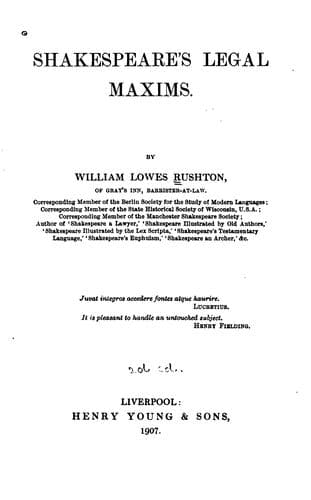
Law in literature; Shakespeare, William, 1564-1616 -- Knowledge -- Law
If a man will prescribe, that if any cattle were upon the demeanes of
the manor, there doing damage, that the lord of the manor for the time
being hath used to distrain them, and the distress to retain till fine
were made to him for the damages at his will, this prescription is void;
because _it is against reason, that if wrong be done any man, that he
thereof should be his own judge_; for by such way, if he had damages
but to the value of a halfpenny, he might assess and have therefor one
hundred pounds, which would be against reason. And so such prescription,
or any other prescription used, if it be against reason, this ought not
nor will not be allowed before judges; Quia malus usus abolendus est. An
evil or invalid custom ought to be abolished (Co. Litt. s. 212). It is
also a maxim of the law of England, that Aliquis non debet esse judex in
propriâ suâ causâ quia non potest esse judex et pars (Co. Litt. 141a).
_Olivia._ This practice hath most shrewdly pass’d upon thee;
But, when we know the grounds and authors of it,
Thou shalt be both the plaintiff and the judge
Of thine own cause.
_Twelfth Night_, Act v. Scene 1.
Portia and Queen Katherine both seem to refer to this maxim; and Olivia
promises, when the persons are discovered who have made Malvolio—
The most notorious geek and gull
That e’er invention play’d on,—
that she will then allow him to be both plaintiff and judge of his own
cause, notwithstanding that Nemo debet esse judex in propriâ suâ causâ.
_Shy._ My deeds upon my head! I crave the law,
The penalty and forfeit of my bond.
_Por._ Is he not able to discharge the money?
_Bass._ Yes, here I tender it for him in the court;
Yea, twice the sum: if that will not suffice,
I will be bound to pay it ten times o’er,
On forfeit of my hands, my head, my heart:
If this will not suffice, it must appear
That malice bears down truth. And, I beseech you,
Wrest once the law to your authority:
To do a great right, do a little wrong;
And curb this cruel devil of his will.
_Por._ It must not be; there is no power in Venice
Can alter a decree established:
’Twill be recorded for a precedent;
And many an error, by the same example,
Will rush into the state: it cannot be.
_Merchant of Venice_, Act iv. Scene 1.
Public-domain text, read in full here on John Shaqi.
Reviews
Reviews
No reviews yet
Be the first to share your thoughts on this work.
Join the Discussion
Join the discussion
Sign in to leave a comment or review.
Sign InorCreate an account