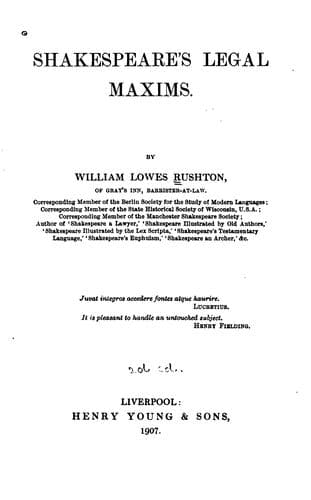
Law in literature; Shakespeare, William, 1564-1616 -- Knowledge -- Law
Portia may expound the law of Venice, but in the English law it is an
established rule to abide by former precedents, stare decisis, where
the same points come again in litigation. An English judge is sworn to
determine, not according to his own private judgment (see per Lord
Camden, 19 Howell’s State Trials, 1071; per Williams, L. 4, Cl. and
Fin. 729), but according to the known laws and customs of the land; not
appointed to pronounce a new law, but to maintain and expound the old,
Jus dicere et non jus dare: (I. Bla. Com. per Lord Kenyon, C. J., 5 T.
R. 682, 6 Id. 605, and 8 Id. 239; per Grose, J., 13 East, 321; per Lord
Hardwick, C. Ellis v. Smith. 1 ves Jun. 16 T. R. 696, I. B. & B. 563).
Stare decisis et non quieta movere—to stand by things as decided, and
not to disturb those things which are tranquil, for Omnis innovatio
plus novitate perturbat quam utilitate prodest (2 Bulstr. 388);—every
innovation occasions more harm and derangement of order by its novelty,
than benefit by its abstract utility. The ancient judges of the law have
ever (as appeareth in our books) suppressed innovations and novelties in
the beginning, as soon as they have offered to creep up, lest the quiet
of the common law might be disturbed, and so have Acts of Parliament
done the like (Co. Litt. 379b). The judges say in one book, ‘We will not
change the law which always hath been used’; and another saith, ‘It is
better that it be turned into a default than the law should be changed,
or any innovation made’ (Co. Litt. 282b).
The rule—stare decisis—does, however, admit of exceptions, where the
former determination is most evidently contrary to reason or divine law.
_Cranmer._ Ah, my good lord of Winchester, I thank you;
You are always my good friend: if you will pass,
I shall both find your lordship judge and juror.
_Henry VIII._, Act v. Scene 2.
Ad quæstionem facti non respondent judices ad quæstionem legis non
respondent juratores (8 Rep. 308).
It is the office of the judge to instruct the jury in points of law—of
the jury to decide on matters of fact. It is the office of the judges
to instruct the grand assize or jury in points of law; for as the grand
assize or other jurors are triers of the matters of fact, ad quæstionem
facti non respondent judices, so, ad quæstionem juris non respondent
juratores. It is of the greatest consequence to the law of England and
to the subject that these powers of the judge and jury be kept distinct,
that the judge determine the law, and the jury the fact; and if ever they
come to be confounded, it will prove the confusion and destruction of the
law of England (Rex v. Poole, Cas. temp. Hardw. 28).
Public-domain text, read in full here on John Shaqi.
Reviews
Reviews
No reviews yet
Be the first to share your thoughts on this work.
Join the Discussion
Join the discussion
Sign in to leave a comment or review.
Sign InorCreate an account