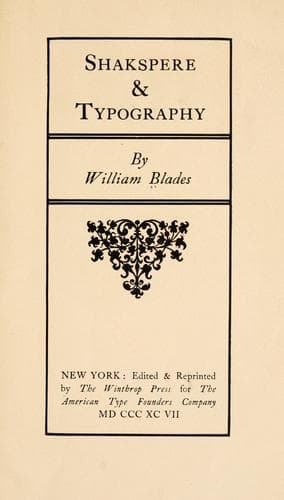
Shakespeare, William, 1564-1616 -- Knowledge -- Book industries and trade
We have already noticed in how simple a manner originated that grand
discovery which, instead of one perishable manuscript, produced numberless
printed books, and thus enabled mankind to perpetuate for ever the
knowledge they had gained. The real superiority of the Press over the pen
was the easy multiplication of copies, and this was the idea in the Poet's
brain when he wrote:
She carved thee for her seal and meant thereby
Thou shouldst _print more_ nor let that copy die.
_Sonnet_ xi.
Type-founding has in these days arrived at such perfection, that most of
the blemishes and faults common in Shakspere's time are now unknown. Under
the old system of hand moulds a type founder was sure when commencing work
to cast a certain number of imperfect letters, because until the mould by
use got warmed, the liquid metal solidified too soon, and the body or
shank of the type was shrunk, and became no inappropriate emblem of an old
man's limbs whose hose would be
A world too wide for his shrunk shank.
_As You Like It_, ii, 7.
The names of the various sizes of type in the sixteenth century were few
compared with our modern list; Canon, Great Primer, Pica, Long Primer, and
Brevier almost complete the catalogue; and however familiar Shakspere may
have been with their names, it is difficult to imagine any scene in which
these technical names could be introduced with propriety. Yet, of one,
Nonpareil, a new small type first introduced from Holland about 1650, and
which for its beauty and excellence was much admired, Shakspere seems to
have conceived a most favorable idea. Prospero, praising his daughter,
calls her 'a Nonpareil' (_Tempest_, Act iii, Sc. 2); Olivia is the
'Nonpareil of beauty' (_Twelfth Night_, Act i, Scene 5); and Posthumus
speaks of Imogen as the 'Nonpareil of her time' (_Cymbeline_, Act ii,
Scene 5).
The exactitude and precision of everything connected with the arrangement
of printing from types is curiously hinted at by Touchstone, when
describing the preciseness of the Courtiers' quarrels:
We quarrel _in print by the book_.
_As You Like It_, v, 4;
that is, no step was taken except according to acknowledged rules.
It often happens when a book comes to its last sheet that the text runs
short, and two or three blank or vacant pages remain at the end. In the
middle of one of these it is usual to place the typographer's imprint.
What compositor is there who has rejoiced in such _fat_ pages[2] but will
not at once recognise the following allusion:
The _vacant_ leaves thy mind's _imprint_ will bear,
And of this _book_ this learning mayst thou taste.
_Sonnet_ lxxvii.
Public-domain text, read in full here on John Shaqi.
Reviews
Reviews
No reviews yet
Be the first to share your thoughts on this work.
Join the Discussion
Join the discussion
Sign in to leave a comment or review.
Sign InorCreate an account