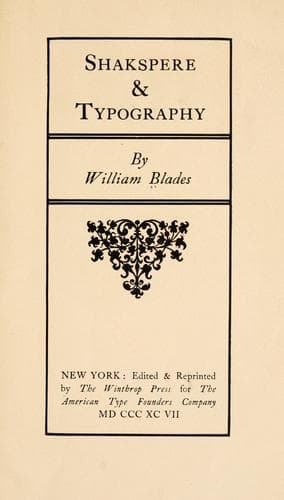
Shakespeare, William, 1564-1616 -- Knowledge -- Book industries and trade
Field did not succeed Vautrollier immediately upon his death. His widow
endeavoured for some time to carry on the business alone; but for some
unknown reason the Stationers' Company withheld their license; and after a
fruitless effort to obtain it, she was succeeded by her son-in-law. These
business changes would probably be the occasion of which Shakspere eagerly
availed himself to join the Players at the neighbouring theatre.
The Sonnets, although not printed until 1609, are generally acknowledged
to be among Shakspere's earliest efforts, and we cannot help imagining
that Sonnet XXIV was written while in the employment of Vautrollier; or
at any rate, while the shop, hung round with prints, was fresh in the
Poet's memory. May be some of their warmth was inspired by the charms of
the buxom widow herself who was apostrophised by the Poet when wishing her
To find where your true image _pictured_ lies,
Which in my bosom's _shop_ is hanging still,
That hath his _windows_ glazed with thine eyes.
_Sonnet_ xxiv.
At any rate, we have here in three lines as many metaphors, and all
derived from just such employment as we suppose Shakspere at that time to
have been engaged in.
Then, again, to a Printer's widow, not over young, what more telling than
the following reference?
Or what strong hand can hold Time's swift foot back?
Or who his spoil of beauty can forbid?
O, none, unless this miracle have might,
That in _black ink_ my love may still shine bright.
_Sonnet_ lxvi.
Note here, that the jet black ink which everybody admires in old
manuscripts was much too thick for a running hand, and had long been
superseded by a writing fluid which, in the 16th century, was far from
equalling the bright gloss of Printing Ink.
Before turning to the internal evidence supplied by Shakspere's writings
in support of our theory, let us glance at the list of works printed and
published by Vautrollier, and see if Shakspere reflected any trace of
their influence upon his mind.
From Herbert's 'Typographical Antiquities' we find that in the 'Shop'
would be the two following works:
_A brief Introduction to Music. Collected by P. Delamote, a Frenchman;
Licensed._
_London_, 8vo., 1574.
_Discursus Cantiones; quæ ab argumento sacræ vocantur, quinque et sex
partivm. Autoribus Thoma Tallisio et Guilielmo Birdo. Cum Privilegio._
_London_, oblong quarto, 1575.
Delamote's Introduction, as well as the Sacred Songs by Tallis and Bird,
were Vautrollier's copyright, and we have already seen how intimate an
acquaintance Shakspere had with music. Might not the above works have been
the mine from which he obtained his knowledge?
Public-domain text, read in full here on John Shaqi.
Reviews
Reviews
No reviews yet
Be the first to share your thoughts on this work.
Join the Discussion
Join the discussion
Sign in to leave a comment or review.
Sign InorCreate an account