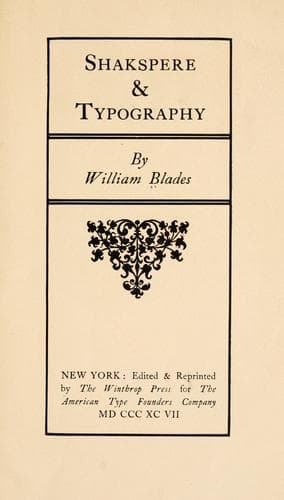
Shakespeare, William, 1564-1616 -- Knowledge -- Book industries and trade
Of religious works, Vautrollier printed and published several, all in
accordance with the principles of the great Reformation, and the writer
who argued that from his intimate knowledge of the tenets of Calvin,
Shakspere must have been himself a Calvinist, would have found sufficient
explanation of his special knowledge in the following books from
Vautrollier's press:
_The Neu Testament, with diversities of Reading and profitable
annotations. An epistle by J. Calvin, prefixed._
4to., 1575:
_Institutio Christianæ Religionis, Joanne Caluino authorè._
8vo., _London_, 1576: and
_The Institution of Christian Religion_ [not in Herbert's Ames]
_written in Latine, by Mr. John Calvine, and translated into English
by Thomas Norton. Imprinted at London, by Thomas Vautrollier._
8vo., 1578.
This last contains an Epistle to the Reader by John Calvin, as well as an
address headed _Typographus Lectori_. Of each of the above works several
editions were published.
In one of his pedantic speeches Holofernes exclaims:
Venetia! Venetia!
Chi non te vede non ti pretia.
Old Mantuan! Old Mantuan! who understandeth thee not, loveth thee not.
_Love's Labour Lost_, iv, 2.
Where did Shakspere learn his Italian, which, although then a court
language, he quotes but rarely, and in an awkward manner? Surely at
second-hand, and probably quoting the phrases current at the period, or
still more probably from conning in his spare moments:
_An Italian Grammer, written in Latin by M. Scipio Lentulo: and turned
into Englishe by Henry Grantham. Typis Tho. Vautrolerij._
_London_, 16mo., 1578.
This was put to press again in 1587. In Vautrollier's 'shop' he would also
have often in his hands:
_Campo di Fior; or else the Flourie field of foure Languages, for the
furtherance of the learners of the Latine, French, English, but
chiefly of the Italian tongue. Imprinted at London, by Thos.
Vautrollier, dwelling in the Black Friers by Ludgate._
16mo., 1583.
Here, again, we have a very extensive Italian vocabulary upon all common
subjects quite sufficient for an occasional quotation; as to the plots
taken from Italian sources, such as 'Romeo and Juliet', it seems to be now
generally admitted that Shakspere in every instance followed the English
translations.
But Shakspere knew also a little French, and uses a few colloquial
sentences here and there. In one play indeed, _Henry V_, iii. 4, there is
a short scene between the Princess and her attendant, in alternate French
and English, which reads almost like a page of a Vocabulary. Shakspere's
knowledge of Latin was apparently about the same in extent; and for the
uses to which he has applied both tongues, the _Flourie Field of Four
Languages_, already quoted as the source of his Italian, would be quite
sufficient. If not, he had the opportunity of consulting under his
master's roof
Public-domain text, read in full here on John Shaqi.
Reviews
Reviews
No reviews yet
Be the first to share your thoughts on this work.
Join the Discussion
Join the discussion
Sign in to leave a comment or review.
Sign InorCreate an account