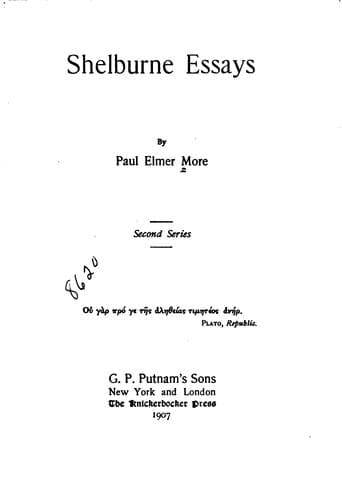
American literature -- History and criticism; English literature -- History and criticism
It begins to grow clear, I think, that we have here something more than
an ordinary tale in which a few individuals are set apart to enact their
rôles. Somehow, this quaint household in the country, where nothing more
important is happening than the birth of a child, becomes a symbol of
the great world with all its tangle of cross-purposes. There is a
philosophy, a new and distinct vision of the meaning of life, in these
scenes, which makes of Sterne something larger than a mere novelist. He
was not indulging his author's vanity when he thought of himself as a
follower of Rabelais and Cervantes and Swift, for he belongs with them
rather than with his great contemporaries, Fielding and Smollet, or his
greater successors, Thackeray and Dickens. Nor is his exact parentage
hard to discover. In Rabelais I seem to see the embryonic humour of a
world coming to the birth and not yet fully formed. Through the crust of
the old mediæval ideals the new humanism was struggling to emerge, and
in its first lusty liberty mankind, with the clog of the old
civilisation still hanging upon it, was like those monsters that Nature
threw off when she was preparing her hand for a higher creation. There
is something unshaped, as of Milton's beast wallowing unwieldy, in the
creatures of Rabelais's brain; yet withal one perceives the pride of the
design that is foreshadowed and will some day come to its own.
Cervantes arose in the full tide of humanism, and there is about his
humour the pathetic regret for an ideal that has been swept aside by the
new forms. For this young civilisation, which spurned so haughtily the
ancient law of humiliation and which was to be satisfied with the full
and unconfined development of pure human nature, had a pitiful
incompleteness to all but a few of Fortune's minions, and the memory of
the past haunted the brain of Cervantes like a ghost vanquished and made
ridiculous, but unwilling to depart. He found therein the tragic humour
of man's ideal life. Then came Swift. Into his heart he sucked the
bitterness of a thousand disappointments. Even the semblance of the old
ideals had passed away, and for the fair promise of the new world he saw
only corruption and folly and a gigantic egotism stalking in the
disguise of liberty. Savage indignation laid hold of him and he vented
his rage in that mocking laughter which stings the ears like a buffet.
His was the sardonic humour. But time that takes away brings also its
compensation. To Sterne, living among smaller men, these passionate
egotisms are dwindled to mere caprices, and a jest becomes more
appropriate than a sneer. And after all, one good thing is left. There
is the kindly heart and the humble acknowledgment that we too are
seeking our own petty ends. It is a world of homely chance into which
Sterne introduces us, and there is no room in it for the boisterous
mirth or the tragedy or wrath of his predecessors. His humour is merely
whimsical; his smile is almost a caress.
Public-domain text, read in full here on John Shaqi.
Reviews
Reviews
No reviews yet
Be the first to share your thoughts on this work.
Elsewhere in the archive
Join the Discussion
Join the discussion
Sign in to leave a comment or review.
Sign InorCreate an account