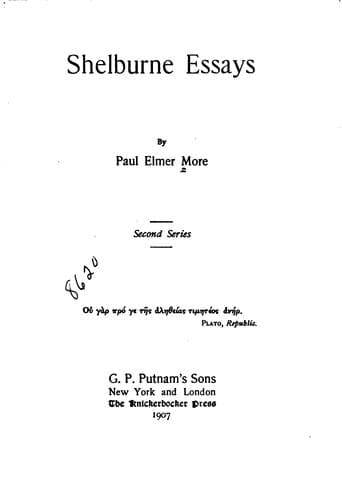
American literature -- History and criticism; English literature -- History and criticism
Now the peculiar good fortune of Scott in this matter was most strongly
brought home to me in reading the narrative work of Mr. Lang. Fine and
entertaining as are Scott's more professedly historical novels, such as
_Ivanhoe_ and _Quentin Durward_, I do not believe they could ever have
resisted the invasion of time were they not bolstered up by the stories
that deal more directly with the realities of Scotch life. There is, to
be sure, in the foreign tales a wonderfully pure vein of romance; but
romantic writing in prose cannot endure unless firmly grounded in
realism, or unless, like Hawthorne's work, it is surcharged with
spiritual meanings. Not having the power possessed by verse to convey
illusion, it lacks also the vitality of verse. Younger readers may take
naturally to _Ivanhoe_ or _The Talisman_, because very little is
required to evoke illusion with them. More mature readers turn oftenest
to _Guy Mannering_ and those tales in which the romance is the realism
of Scotch life, finding here a fulness of interest that is more than a
compensation for the frequent slovenliness of Scott's language and for
the haphazard construction of his plots.
These negligences of the indifferent craftsman might, perhaps, need no
such compensation, for we have grown hardened at last to slovenliness
in fiction. But there are other limitations to Scott's powers that show
more clearly how much of his fame rests on the substratum of national
life on which he builds. An infinite variety of characters, from kings
in the council hall down to strolling half-witted gaberlunzies, move
through the pages of his novels; but, and the fact is notorious, the
great Scotchman was little better at painting the purple light of young
desire than was our own Cooper. There is something like love-making in
_Rob Roy_, and Di Vernon has been signalised by Mr. Saintsbury as one of
his five chosen heroines; but in general the scenes that form the
ecstasy of most romance are dead and perfunctory in Scott. And this is
the more remarkable since we know that he himself was a lover--and a
disappointed lover, which is vastly more to the point in art, as all the
world knows. But in fact this inability to portray the softer emotions
is not an isolated phenomenon in Scott; he skims very lightly over most
of the deeper passions of the heart, seeming to avoid them except in so
far as they express themselves in action. His novels contain no adequate
picture of remorse or hatred, love or jealousy; neither do they contain
any such psychological analysis of the emotions as has made the fame of
subsequent writers. But there is an infinite variety of characters in
action, and a perfect understanding of that form of the imagination
which displays itself in whimsicalities corresponding to the
"originals" or "humourists" of the Elizabethan comedy.
Public-domain text, read in full here on John Shaqi.
Reviews
Reviews
No reviews yet
Be the first to share your thoughts on this work.
Join the Discussion
Join the discussion
Sign in to leave a comment or review.
Sign InorCreate an account