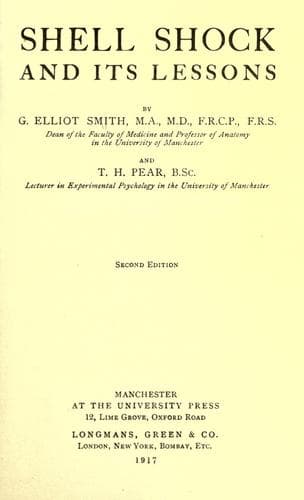
Traumatic neuroses; War neuroses; World War, 1914-1918 -- Health aspects; World War, 1914-1918 -- Veterans -- Mental health
It should be unnecessary to emphasise the desirability of preventing
the neurasthenic from dwelling upon his subjective troubles by
occupying his mind with other things. This end may often be achieved
by the provision of suitable occupation, and where possible, for
many obvious reasons, this occupation should take the form of useful
work. The worker then feels that he is not a mere burden upon the
hospital which is treating him: the institution in its turn benefits
materially. But it is necessary to sound a note of warning against
the indiscriminate prescription of work as a panacea. First of all it
should be certain that the work is of such a kind as really to interest
the patient and to occupy his mind. There are many varieties of work,
especially of manual labour, which can be performed mechanically, and
do not succeed in distracting the attention from worries and anxieties.
But more important even than this is the consideration that there are
some mental troubles from which no form of work will distract the
patient. Especially is this the case in many of the psychoneuroses
caused by the war. The sufferer is often haunted day and night by
memories which torture him not merely by their horror but also by
another aspect which is even worse: the ever-increasing moral remorse
which they induce. A patient may be troubled not only by the terrible
nature of the memory but by the recurring thought, “If I had not
done” this or that, “it might never have happened.” The reader will
easily see how such a thought may arise in the mind, especially of a
nerve-stricken officer or “N.C.O.” after weeks of brooding in private
upon the memory of a disaster. Now, such self-reproaches are frequently
based upon entirely insufficient evidence, and if the medical officer
is given the opportunity of calmly discussing their foundations with
the patient, the result is often to reassure him and to enable him to
view his past in an entirely new light. It is then, and not before
then, that he will be able cheerfully to enter upon useful occupation
and to benefit by it. To suppose that the mere physical fatigue
induced by a day’s hard work will banish all forms of insomnia betrays
an ignorance of one of the most important causes of this malady;
_viz._, mental conflict. It is well known that bodily fatigue in the
case of a mentally excited patient may merely increase his unrest at
night. Again, anyone who has had a few months’ experience of receiving
the confidence of these nerve-stricken soldiers will know that some of
their troubles are so poignant that the attractions of the (apparently)
most interesting kinds of occupation leave them cold.
Public-domain text, read in full here on John Shaqi.
Reviews
Reviews
No reviews yet
Be the first to share your thoughts on this work.
Join the Discussion
Join the discussion
Sign in to leave a comment or review.
Sign InorCreate an account