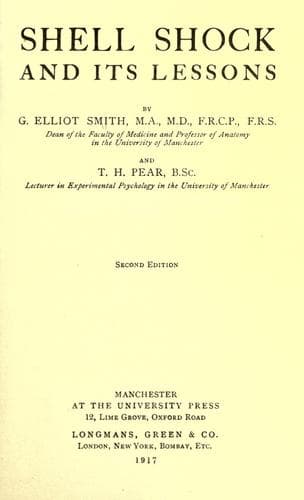
Traumatic neuroses; War neuroses; World War, 1914-1918 -- Health aspects; World War, 1914-1918 -- Veterans -- Mental health
Perhaps few terms in medicine have aroused so much misunderstanding,
so much criticism, well-informed and ill-informed—and so much enmity
as this word “psychoanalysis.” This latter fact alone, however, should
not prejudice the reader for or against it. He will probably remember
that it is the exception, rather than the rule, for an innovation to be
received without hostility, not only from the general public, but also
from experts who work in provinces bordering upon the field in which
the new method is introduced.
It should be pointed out that much of the heated discussion which has
raged around this word psychoanalysis is due to the fact that the
term has different meanings, as used, not only by its enemies, but by
its friends. Psychoanalysis, according to Dr. Jung, is a _method_;
“a method which makes possible the analytic reduction of the psychic
content to its simplest expression, and the discovery of the line of
least resistance in the development of a harmonious personality.”[48]
Psychoanalysis is therefore a method of psychological analysis. Why,
then, have we not used the term psychoanalysis in the earlier part of
the book? It was purely to avoid unnecessary and acrimonious discussion
on any particular doctrinal aspect of the question which this term may
be taken to imply.
It is clear to every thinking person that, in analysing a mental state
the physician should use every legitimate means at his disposal. If
these means include, as they do, the valuable assistance derived
from the study of the patient’s dreams, his “associations” whether
free or constrained,[49] and other mental phenomena, the doctor may
use them freely without thereby subscribing to any one “doctrine of
psychoanalysis.”
The term psychoanalysis has been widely applied, not only to the
diagnostic method, but also to the theories which underlie and
determine the subsequent process of re-education. This seems to be a
misuse of the useful word “analysis.” It may be objected that in all
scientific analysis there is some directive hypothesis to be confirmed
or disproved, and that in this sense all analysis is based on theory.
This is true, but it seems inadvisable to confuse the analytic process
with the theory which directs one form of it.
When we come to consider the theoretical presuppositions which underlie
the different methods of re-education adopted by various physicians,
it is not surprising, at this early stage of our knowledge, to discover
differences of opinion. The physician will find at every step that in
“tidying up” the disentangled functions of the patient’s mentality he
will need not one theory but many, for his problem is life itself.
Public-domain text, read in full here on John Shaqi.
Reviews
Reviews
No reviews yet
Be the first to share your thoughts on this work.
Join the Discussion
Join the discussion
Sign in to leave a comment or review.
Sign InorCreate an account