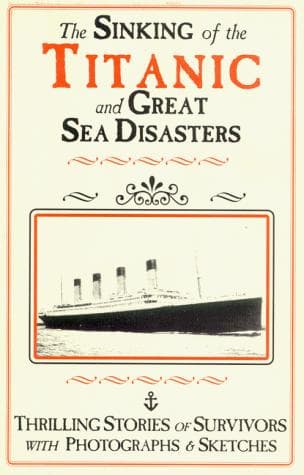
Shipwrecks -- North Atlantic Ocean; Titanic (Steamship)
CHAPTER II. THE MOST SUMPTUOUS PALACE AFLOAT
DIMENSIONS OF THE TITANIC--CAPACITY--PROVISIONS FOR THE COMFORT AND
ENTERTAINMENT OF PASSENGERS--MECHANICAL EQUIPMENT THE ARMY OF ATTENDANTS
REQUIRED.
THE statistical record of the great ship has news value at this time.
Early in 1908 officials of the White Star Company announced that they
would eclipse all previous records in shipbuilding with a vessel of
staggering dimensions. The Titanic resulted.
The keel of the ill-fated ship was laid in the summer of 1909 at the
Harland & Wolff yards, Belfast. Lord Pirrie, considered one of the
best authorities on shipbuilding in the world, was the designer. The
leviathan was launched on May 31, 1911, and was completed in February,
1912, at a cost of $10,000,000.
SISTER SHIP OF OLYMPIC
The Titanic, largest liner in commission, was a sister ship of the
Olympic. The registered tonnage of each vessel is estimated as 45,000,
but officers of the White Star Line say that the Titanic measured 45,328
tons. The Titanic was commanded by Captain E. J. Smith, the White Star
admiral, who had previously been on the Olympic.
She was 882 1/2 long, or about four city blocks, and was 5000 tons
bigger than a battleship twice as large as the dreadnought Delaware.
Like her sister ship, the Olympic, the Titanic was a four-funneled
vessel, and had eleven decks. The distance from the keel to the top of
the funnels was 175 feet. She had an average speed of twenty-one knots.
The Titanic could accommodate 2500 passengers. The steamship was divided
into numerous compartments, separated by fifteen bulkheads. She was
equipped with a gymnasium, swimming pool, hospital with operating room,
and a grill and palm garden.
CARRIED CREW OF 860
The registered tonnage was 45,000, and the displacement tonnage 66,000.
She was capable of carrying 2500 passengers and the crew numbered 860.
The largest plates employed in the hull were 36 feet long, weighing 43
1/2 tons each, and the largest steel beam used was 92 feet long, the
weight of this double beam being 4 tons. The rudder, which was operated
electrically, weighed 100 tons, the anchors 15 1/2 tons each, the center
(turbine) propeller 22 tons, and each of the two "wing" propellers 38
tons each. The after "boss-arms," from which were sus-pended the three
propeller shafts, tipped the scales at 73 1/2 tons, and the forward
"boss-arms" at 45 tons. Each link in the anchor-chains weighed 175
pounds. There were more than 2000 side-lights and windows to light the
public rooms and passenger cabins.
Nothing was left to chance in the construction of the Titanic. Three
million rivets (weighing 1200 tons) held the solid plates of steel
together. To insure stability in binding the heavy plates in the double
bottom, half a million rivets, weighing about 270 tons, were used.
Public-domain text, read in full here on John Shaqi.
Reviews
Reviews
No reviews yet
Be the first to share your thoughts on this work.
Join the Discussion
Join the discussion
Sign in to leave a comment or review.
Sign InorCreate an account