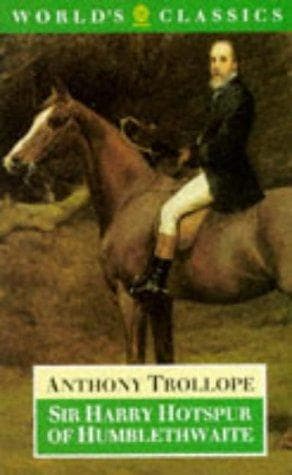
Sir Harry Hotspur of HumblethwaiteTrollope, Anthony
General
Sir Harry Hotspur of Humblethwaite
Trollope, Anthony
Cumberland (England) -- Fiction; Domestic fiction; Fathers and daughters -- Fiction; Inheritance and succession -- Fiction
The Hall, as the great house at Humblethwaite was called, consisted
in truth of various edifices added one to another at various periods;
but the result was this, that no more picturesque mansion could be
found in any part of England than the Hall at Humblethwaite. The
oldest portion of it was said to be of the time of Henry VII.; but it
may perhaps be doubted whether the set of rooms with lattice windows
looking out on to the bowling-green, each window from beneath its
own gable, was so old as the date assigned to it. It is strange how
little authority can usually be found in family records to verify
such statements. It was known that Humblethwaite and the surrounding
manors had been given to, or in some fashion purchased by, a certain
Harry Hotspur, who also in his day had been a knight, when Church
lands were changing hands under Henry VIII. And there was authority
to prove that that Sir Harry had done something towards making a
home for himself on the spot; but whether those very gables were a
portion of the building which the monks of St. Humble had raised for
themselves in the preceding reign, may probably be doubted. That
there were fragments of masonry, and parts of old timber, remaining
from the monastery was probably true enough. The great body of the
old house, as it now stood, had been built in the time of Charles
II., and there was the date in the brickwork still conspicuous on the
wall looking into the court. The hall and front door as it now stood,
very prominent but quite at the end of the house, had been erected in
the reign of Queen Anne, and the modern drawing-rooms with the best
bedrooms over them, projecting far out into the modern gardens, had
been added by the present baronet's father. The house was entirely
of brick, and the old windows,--not the very oldest, the reader will
understand, but those of the Caroline age,--were built with strong
stone mullions, and were longer than they were deep, beauty of
architecture having in those days been more regarded than light. Who
does not know such windows, and has not declared to himself often
how sad a thing it is that sanitary or scientific calculations
should have banished the like of them from our houses? Two large
oriel windows coming almost to the ground, and going up almost to
the ceilings, adorned the dining-room and the library. From the
drawing-rooms modern windows, opening on to a terrace, led into the
garden.
Public-domain text, read in full here on John Shaqi.
Reviews
Reviews
No reviews yet
Be the first to share your thoughts on this work.
Join the Discussion
Join the discussion
Sign in to leave a comment or review.
Sign InorCreate an account