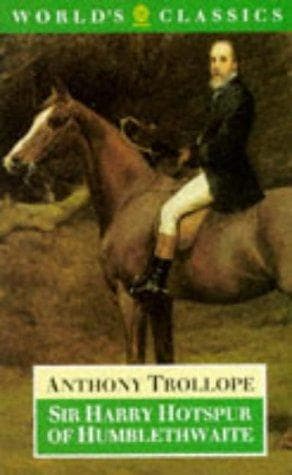
Sir Harry Hotspur of HumblethwaiteTrollope, Anthony
General
Sir Harry Hotspur of Humblethwaite
Trollope, Anthony
Cumberland (England) -- Fiction; Domestic fiction; Fathers and daughters -- Fiction; Inheritance and succession -- Fiction
You entered the mansion by a court that was enclosed on two sides
altogether, and on the two others partially. Facing you, as you drove
in, was the body of the building, with the huge porch projecting on
the right so as to give the appearance of a portion of the house
standing out on that side. On the left was that old mythic Tudor
remnant of the monastery, of which the back wall seen from the court
was pierced only with a small window here and there, and was covered
with ivy. Those lattice windows, from which Emily Hotspur loved to
think that the monks of old had looked into their trim gardens, now
looked on to a bowling-green which was kept very trim in honour of
the holy personages who were supposed to have played there four
centuries ago. Then, at the end of this old building, there had been
erected kitchens, servants' offices, and various rooms, which turned
the corner of the court in front, so that only one corner had, as
it were, been left for ingress and egress. But the court itself was
large, and in the middle of it there stood an old stone ornamental
structure, usually called the fountain, but quite ignorant of water,
loaded with griffins and satyrs and mermaids with ample busts, all
overgrown with a green damp growth, which was scraped off by the
joint efforts of the gardener and mason once perhaps in every five
years.
It often seems that the beauty of architecture is accidental. A great
man goes to work with great means on a great pile, and makes a great
failure. The world perceives that grace and beauty have escaped him,
and that even magnificence has been hardly achieved. Then there grows
up beneath various unknown hands a complication of stones and brick
to the arrangement of which no great thought seems to have been
given; and, lo, there is a thing so perfect in its glory that he who
looks at it declares that nothing could be taken away and nothing
added without injury and sacrilege and disgrace. So it had been, or
rather so it was now, with the Hall at Humblethwaite. No rule ever
made for the guidance of an artist had been kept. The parts were out
of proportion. No two parts seemed to fit each other. Put it all on
paper, and it was an absurdity. The huge hall and porch added on by
the builder of Queen Anne's time, at the very extremity of the house,
were almost a monstrosity. The passages and staircases, and internal
arrangements, were simply ridiculous. But there was not a portion
of the whole interior that did not charm; nor was there a corner of
the exterior, nor a yard of an outside wall, that was not in itself
eminently beautiful.
Public-domain text, read in full here on John Shaqi.
Reviews
Reviews
No reviews yet
Be the first to share your thoughts on this work.
Join the Discussion
Join the discussion
Sign in to leave a comment or review.
Sign InorCreate an account