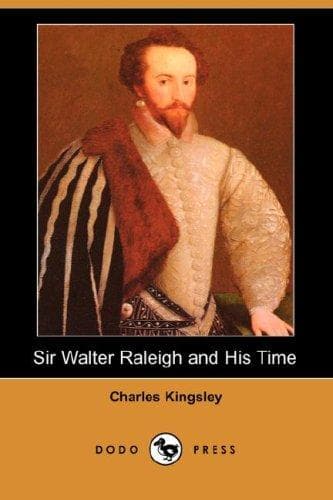
Great Britain -- History; Raleigh, Walter, Sir, 1552?-1618
Transcribed from “Plays and Puritans and Other Historical Essays” 1890
Macmillan and Co. edition by David Price, email ccx074@pglaf.org
SIR WALTER RALEIGH AND HIS TIME {87}
‘TRUTH is stranger than fiction.’ A trite remark. We all say it again
and again: but how few of us believe it! How few of us, when we read the
history of heroical times and heroical men, take the story simply as it
stands! On the contrary, we try to explain it away; to prove it all not
to have been so very wonderful; to impute accident, circumstance, mean
and commonplace motives; to lower every story down to the level of our
own littleness, or what we (unjustly to ourselves and to the God who is
near us all) choose to consider our level; to rationalise away all the
wonders, till we make them at last impossible, and give up caring to
believe them; and prove to our own melancholy satisfaction that Alexander
conquered the world with a pin, in his sleep, by accident.
And yet in this mood, as in most, there is a sort of left-handed truth
involved. These heroes are not so far removed from us after all. They
were men of like passions with ourselves, with the same flesh about them,
the same spirit within them, the same world outside, the same devil
beneath, the same God above. They and their deeds were not so very
wonderful. Every child who is born into the world is just as wonderful,
and, for aught we know, might, _mutatis mutandis_, do just as wonderful
deeds. If accident and circumstance helped them, the same may help us:
have helped us, if we will look back down our years, far more than we
have made use of.
They were men, certainly, very much of our own level: but may we not put
that level somewhat too low? They were certainly not what we are; for if
they had been, they would have done no more than we: but is not a man’s
real level not what he is, but what he can be, and therefore ought to be?
No doubt they were compact of good and evil, just as we: but so was
David, no man more; though a more heroical personage (save One) appears
not in all human records but may not the secret of their success have
been that, on the whole (though they found it a sore battle), they
refused the evil and chose the good? It is true, again, that their great
deeds may be more or less explained, attributed to laws, rationalised:
but is explaining always explaining away? Is it to degrade a thing to
attribute it to a law? And do you do anything more by ‘rationalising’
men’s deeds than prove that they were rational men; men who saw certain
fixed laws, and obeyed them, and succeeded thereby, according to the
Baconian apophthegm, that nature is conquered by obeying her?
But what laws?
To that question, perhaps, the eleventh chapter of the Epistle to the
Hebrews will give the best answer, where it says, that by faith were done
all the truly great deeds, and by faith lived all the truly great men who
have ever appeared on earth.
Public-domain text, read in full here on John Shaqi.
Reviews
Reviews
No reviews yet
Be the first to share your thoughts on this work.
Join the Discussion
Join the discussion
Sign in to leave a comment or review.
Sign InorCreate an account