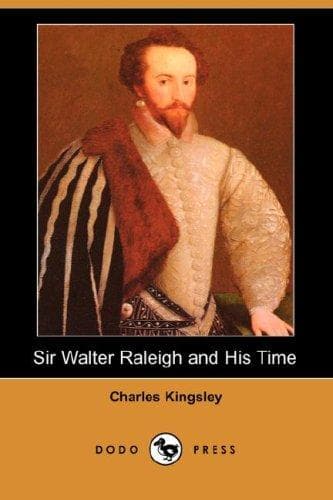
Great Britain -- History; Raleigh, Walter, Sir, 1552?-1618
There are, of course, higher and lower degrees of this faith; its object
is one more or less worthy: but it is in all cases the belief in certain
unseen eternal facts, by keeping true to which a man must in the long run
succeed. Must; because he is more or less in harmony with heaven, and
earth, and the Maker thereof, and has therefore fighting on his side a
great portion of the universe; perhaps the whole; for as he who breaks
one commandment of the law is guilty of the whole, because he denies the
fount of all law, so he who with his whole soul keeps one commandment of
it is likely to be in harmony with the whole, because he testifies of the
fount of all law.
I shall devote a few pages to the story of an old hero, of a man of like
passions with ourselves; of one who had the most intense and awful sense
of the unseen laws, and succeeded mightily thereby; of one who had hard
struggles with a flesh and blood which made him at times forget those
laws, and failed mightily thereby; of one whom God so loved that He
caused each slightest sin, as with David, to bring its own punishment
with it, that while the flesh was delivered over to Satan, the man
himself might be saved in the Day of the Lord; of one, finally, of whom
nine hundred and ninety-nine men out of a thousand may say, ‘I have done
worse deeds than he: but I have never done as good ones.’
In a poor farm-house among the pleasant valleys of South Devon, among the
white apple-orchards and the rich water-meadows, and the red fallows and
red kine, in the year of grace 1552, a boy was born, as beautiful as day,
and christened Walter Raleigh. His father was a gentleman of ancient
blood: few older in the land: but, impoverished, he had settled down upon
the wreck of his estate, in that poor farm-house. No record of him now
remains; but he must have been a man worth knowing and worth loving, or
he would not have won the wife he did. She was a Champernoun, proudest
of Norman squires, and could probably boast of having in her veins the
blood of Courtneys, Emperors of Byzant. She had been the wife of the
famous knight Sir Otho Gilbert, and lady of Compton Castle, and had borne
him three brave sons, John, Humphrey, and Adrian; all three destined to
win knighthood also in due time, and the two latter already giving
promises, which they well fulfilled, of becoming most remarkable men of
their time. And yet the fair Champernoun, at her husband’s death, had
chosen to wed Mr. Raleigh, and share life with him in the little
farm-house at Hayes. She must have been a grand woman, if the law holds
true that great men always have great mothers; an especially grand woman,
indeed; for few can boast of having borne to two different husbands such
sons as she bore. No record, as far as we know, remains of her; nor of
her boy’s early years. One can imagine them, nevertheless.
Public-domain text, read in full here on John Shaqi.
Reviews
Reviews
No reviews yet
Be the first to share your thoughts on this work.
Join the Discussion
Join the discussion
Sign in to leave a comment or review.
Sign InorCreate an account