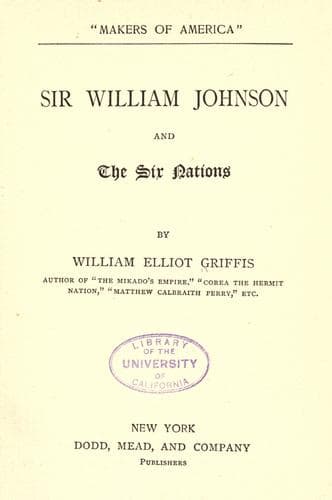
Sir William Johnson and the Six NationsGriffis, William Elliot
History
Sir William Johnson and the Six Nations
Griffis, William Elliot
Johnson, William, 1715-1774; United States -- History -- French and Indian War, 1754-1763
This is the doctrine on which republics are
founded.
Largely due to Johnson’s influence was the passing by the Assembly of an
act for the better survey and allotment of lands in the province. At the
English conquest of 1664 the excellent Dutch customs of land survey,
measurement, registry, and allotment had been changed for the tedious
forms of English common law. In consequence, there was much confusion in
regard to claims and boundaries. Large tracts of land had been granted
by the British Government, under letters patent, in which the exact
quantity of land given away was not stated, nor the correct boundaries
named. Further, the popular methods of measurement in vogue—such as by
counting off the steps made by a grown man, or by using horse-reins or
bridles in lieu of a surveyor’s chain—were not calculated to insure
accuracy. Not only were constant trespassings made, both with honest and
dishonest intent, upon the king’s domain,—that is, the lands of the
Indians,—but there were frequent troubles about the division of the
great patents. The lawyers held that when the boundaries were uncertain,
the title was void. The only way to settle the many disputes was to have
all the patents and tracts accurately surveyed by the king’s
surveyor-general, and done in so scientific a manner that his lines
should be final; while the names of the patentees, the size of the
patent, and the year when patented, should be matter of public
knowledge. The good fruits of this piece of legislation were the removal
of much of the irritation felt by the Indians, and the prevention of
further encroachments on the royal lands.
In a word, close approximation was made to the methods followed in the
Republic of Holland for centuries, and established in the New
Netherlands by the first settlers from the Fatherland. After the
Revolution, under the Surveyor-General of the United States, Simeon De
Witt, a Hollander by descent, and familiar with the Dutch methods, this
system, enlarged and improved, became that of the whole nation from the
Atlantic to the Pacific. It is this system, lying at the basis of the
land laws of the United States, which so won the encomium of Daniel
Webster in his great address at Plymouth, when he said that our laws
relating to land had made the American Republic.
Public-domain text, read in full here on John Shaqi.
Reviews
Reviews
No reviews yet
Be the first to share your thoughts on this work.
Elsewhere in the archive
Join the Discussion
Join the discussion
Sign in to leave a comment or review.
Sign InorCreate an account