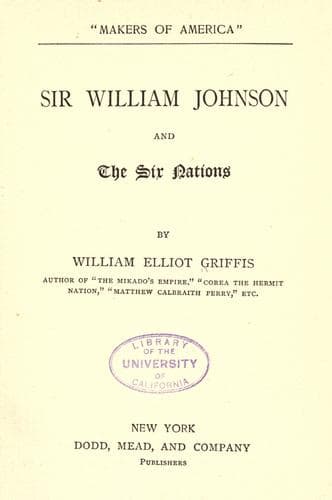
Sir William Johnson and the Six NationsGriffis, William Elliot
History
Sir William Johnson and the Six Nations
Griffis, William Elliot
Johnson, William, 1715-1774; United States -- History -- French and Indian War, 1754-1763
Some time afterward, the Mohawks, who had forgotten the covenants of the
past, thereby showing the worthlessness of mere tradition or unsupported
assertions freshly fabricated, claimed that “the great flat,” or large
tract of fertile land near Schenectady, had not been purchased of them,
but had been lent to the Dutch settlers simply as pasture-land. On their
making complaint to Johnson, the documents were called for, and duly
produced by the magistrates of Schenectady. The deed of sale to Van
Curler and his fellow-settlers, made in Fort Orange, July 27, 1661
(“Actum in de fort^{ss} Orangie den 27^{e} July A. 1661”), was first
produced. On it were the signatures or marks of the sachems Cantuquo,
Aiadne, and Sonareetsie, with the totem-signs of the Bear, Tortoise, and
Wolf. Other papers of later date were shown, which set more definite
boundaries to the patent of eighty thousand acres. Johnson declared the
Schenectady men in the right. The Indians, with perfect confidence in
Johnson as arbitrator, went to their bark houses satisfied.
From this time forth until the end of his life, a large part of
Johnson’s time was occupied in the settlement of land disputes between
whites and Indians. Ceasing to be any longer a political factor in the
future development of the continent, the Indian’s course was steadily
downward. Having exhausted the benefit of his service, the British and
colonial governments were both only too ready to ignore the red man’s
real or supposed rights. Steadily the frontiers of civilization were
pushed forward upon the broad and ancient hunting-grounds of the West.
In the old and thickly settled domain of the Iroquois, it was now
scarcely possible for an Indian to chase deer without running into a
fence or coming unexpectedly upon a clearing where the white man stood,
gun in hand, to warn off intruders. The saw-mills of the pale-face
spoiled the primeval forests, choked the trout-streams with sawdust, and
killed the fish, even as his traps and ploughed land drove off the game.
Henceforth, though Johnson’s business with the Indians was greater than
ever before, it was largely matter of laborious detail and settled
routine. Important as was his work to the perfecting of the results
attained by the annulling of French pretensions, it would be monotonous
to tell the whole story. His toil was necessary to the uniformity
desirable in all the king’s dominions, yet it lacked the picturesque
element dominant in his early life, and need not here be set forth. We
may take notice only of the most important of his labours as examiner of
claims, as advocate for the right, and as judge and decider.
Public-domain text, read in full here on John Shaqi.
Reviews
Reviews
No reviews yet
Be the first to share your thoughts on this work.
Elsewhere in the archive
Join the Discussion
Join the discussion
Sign in to leave a comment or review.
Sign InorCreate an account